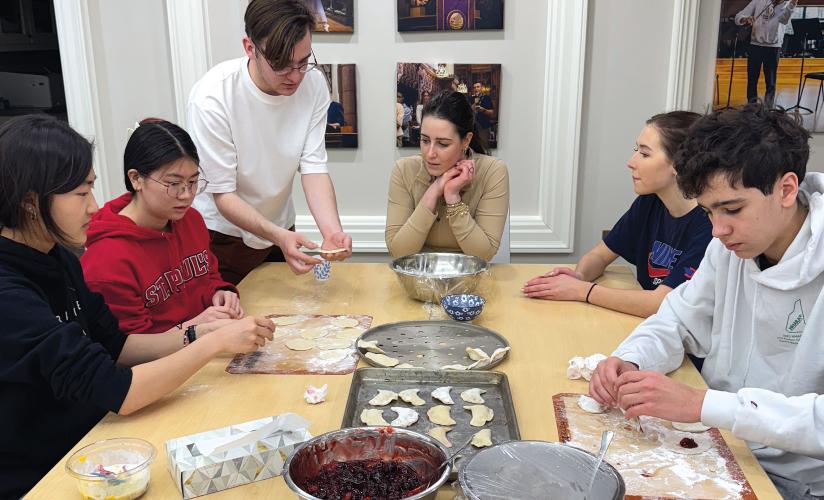
Members of the Ukraine Culture Club find camaraderie together and share a deep dive into the country with a curious School community.


Fourth Formers Sofia Recchi and Caroline Anttila publish a bilingual children’s book celebrating Colombian heritage, identity and storytelling.
BY IAN ALDRICH
On a Saturday morning in late January, Caroline Anttila ’28 and Sofia Recchi ’28 were having coffee with Sofia’s father in downtown Concord when their breakfast banter came to a sudden halt. The elder Recchi flashed his phone in front of the two Fourth Formers. “It’s out!” he exclaimed with excitement. The best friends looked in disbelief.
Over the prior month the pair had closely collaborated on a children’s book that Recchi wrote and Anttila illustrated. “Un Paseo al Corazón: A Journey to the Heart” tells the story of a young girl named Luna who travels to her parents’ native Colombia for the first time, exploring a new culture and meeting new family members along the way.
For the two best friends, the book had been its own kind of journey: late night brainstorming, edits and proofs, rounds of back-and-forth. Now, however, the project Recchi and Anttila had worked so hard on had finally launched. It didn’t feel real.
“We were both little stunned to finally see it up on Amazon,” says Anttila, who focused most of her winter vacation on creating the 30 illustrations that accompany the 47-page book. “It wasn’t like we hadn’t seen the cover before, but there it was out in the world. It’s been my dream to work on children’s book and now it had finally happened.”
While the book required a lot of time, Anttila says it never felt like work. She loved the story and the challenge of bringing Recchi’s writing to life. She also loved what the narrative meant to Recchi, whose family hails from Colombia. But perhaps more than anything, she found the obligation and routine of making new work nearly every day to be invigorating.
“I wasn’t able to take any art classes during Fall Term,” says Anttila, “so to be able work on this project was important to me. There was some pressure because I wanted to represent Sofia’s story as well as possible and I knew other people were going to see what I produced. I had this extra motivation to work even harder.”
The book’s origin story begins last fall. Recchi had been thinking deeply about Colombia and her family there, whom she and her parents visit at least three times a year. Her family’s heritage fascinated her, as did the themes of cultural identity and what it means to explore a sense of place that can feel both familiar and foreign. She had no designs on being a writer, but as she contemplated the best way to express what interested her, the more she felt compelled to create something that was both accessible and illustrative.
“When I thought about it, it was always going to be a children’s book,” says Recchi. “But I wasn’t sure I could do it. It felt like a big idea.”
Then, one afternoon in early October, an unexpected block of free time opened up when one of her classes was canceled. Recchi plunked herself down in the library and started writing.
“The most challenging part was thinking of the plot,” she says. “Originally the story was going to be about a young girl who has this school assignment to draw her home but that didn’t seem to be a fit for young children. So then I came up with this idea that Luna would take this little journey around Colombia, visiting family and different important sites. It was a lot of trial and error.”
Over the next two months, Recchi developed and polished the text, writing at night, during study hall and on weekends — whenever she could find some free time. She told nobody about the project except Spanish Teacher Eblin Molina, who helped her edit and translate the text, which is in both Spanish and English. Along the way, Recchi pored over other children’s books to examine their formatting, illustrations and story sequencing. Then, on Christmas Eve she called Anttila and clued her in to what she’d been doing.
“I had no idea,” Anttila says with a laugh. “This whole time she’d been keeping it to herself.”
Toward the end of that December phone call, Recchi then surprised her friend even further. “How would you like to illustrate it?” she asked.
“I’ll come up with some ideas,” Anttila answered excitedly.
In her best friend, Recchi knew she had an ideal collaborator. Almost from the moment Anttila was able to hold a paint brush in her hands, she has identified as an artist. “When I’m working, it’s a safe place,” she explains. “It’s where I can be who I want to be.”
At St. Paul’s, Anttila found a school that supported her artistic passions unconditionally, and over the last two years she has leveraged the arts program to further hone her skills in oils and charcoal. Last spring’s graduation program even featured her painting of the Chapel of St. Peter and St. Paul on the front cover.
For “Un Paseo al Corazón,” Anttila was able to build an entire set of visuals from scratch. Recchi says she gave her friend some guidance but largely trusted her friend to interpret the text.
In the weeks since the book was published, “Un Paseo al Corazón” has received wide praise. Family members, teachers and fellow students all have bought it, and Recchi and Anttila have even begun booking readings at a few nearby schools. Most meaningful, perhaps, is the recognition the book has garnered from different pockets of Colombian-American community. In mid-February, Recchi and Anttila presented the book to a group in Nashua.
“I want people to feel proud of where they come from,” says Recchi. “That’s what Luna learns as she travels around Colombia. It’s okay to celebrate who you are and carry your roots around in your heart, no matter where you live or wherever you go.”