The 2025 Fall Term Living in Community day offers a crash course in adulthood.


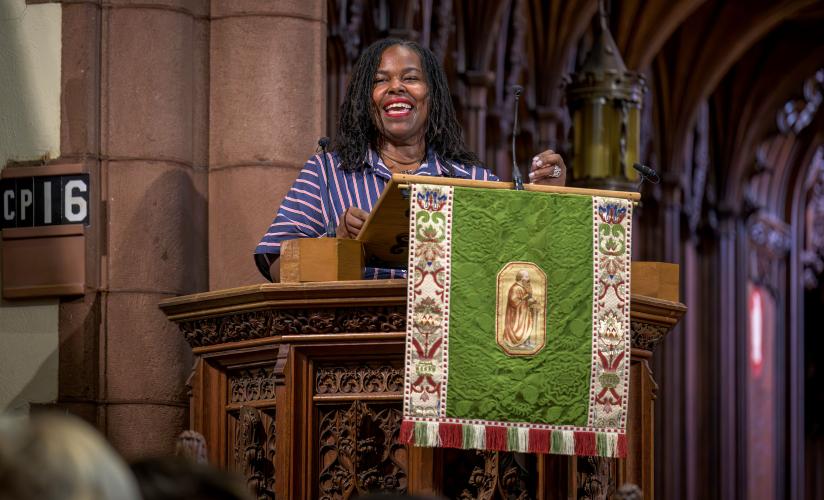
Rector Kathy Giles reflects on the pain — and power — of personal setbacks in her Winter Convocation remarks.
Welcome back! I hope your break was restful. I know that for many of us, it was very busy. From SAT boot camp to tournaments and showcases, auditions and applications, not to mention grades, comments, and adviser comments, there has been a lot to do, in addition to hopefully enjoying some time with friends and family and that all-important element to Thanksgiving, some good food.
And the busy times certainly don’t end anytime soon. When the calendar turns to December, it gets an added layer of hype. As soon as the holiday lights go up, our sense of anticipation builds. It’s the season of gifts and giving, but also of getting. We’ll have some great fun here during the next couple of weeks, and we’re all looking forward to the upcoming performances of the Nutcracker and Lessons & Carols, the Hannukah party, skating with Santa, secret snowflakes, the holiday feast and Celebration of Light. Tis the season for gifts, giving, and light. And, as it is also the season of getting, we might be wondering what happens when grades come out, or when the early college news starts arriving in earnest. When we think of getting, what we hope for, we tend to get pretty specific: I hope I get a good grade; I hope I did well; I hope I get into my ED school. It’s a time of year during which it is easy to confuse hope with want, the same way that we might have confused a Christmas or Hannukah wish for a specific ask when we were younger. I wish for; I hope for; I want to get. Nobody likes being disappointed or disappointing anyone else — in fact, disappointment can seem like the worst outcome, in this season of gifts, giving, and getting.
Every year at this time, I reflect back to December 1983, when I was a college senior. I wanted good grades; I wanted to be an all-star ice hockey player; I wanted to get into law school — but what I wanted most of all was to be selected as a Rhodes Scholar. The Rhodes Scholarship is a prestigious, fully-funded two-to-four year program of study at the University of Oxford in the UK, awarded to students with strong academic performance and demonstrated physical vigor, character, and leadership. It was everything I wanted to do and be, and once I learned about the Rhodes Scholarship during my freshman year of college, it became my ultimate goal.
And I mean that it really became my ultimate goal, what I wanted most. I was willing to sacrifice and work for it. I’m the oldest of five children in my birth family, and there was no way my family could afford to have me travel or spend more time studying after college. In the summers, I made money for school by working days in an office doing insurance forms, and in the early mornings and late afternoons I trained hard — yes, for hockey, but also for the Rhodes. I would tell myself, If I can run two more miles, if I can sprint the last two hundred yards up the hill, if I can do five more reps, I can get the Rhodes. Back at school, I would tell myself, If I can put in another hour on the econ problem set or on the English paper I needed to write and wanted to write perfectly, I can get the Rhodes. If I did the honors program and got an A on my junior thesis; if I went to office hours so I really understood the professor’s article and could prove it on the test; if I did the extra set of stadiums, the extra sprints — I could get the Rhodes. I wanted it, I hoped for it, I worked for it — I did everything I could for two years, focusing on getting the Rhodes. I wanted the opportunity, the honor, the credential, the distinction — everything about it. And everyone knew it: my parents, their friends, my coaches, my teammates, my professors. Everyone. All that work made a big difference in everything I did. I got better, faster, stronger in every way. But that wasn’t what I was after. I wanted to get the Rhodes.
So, at Thanksgiving of my senior year in college, I was summoned, along with 11 other college seniors who lived in the state of Maine, to the state final interviews. And yes, I was one of two selected from Maine to go to the New England final rounds. There would be 16 finalists from New England, and four Rhodes Scholars would selected that day. I knew a few finalists from my college, including the other finalist from Maine. She had already graduated and was doing a fellowship at the Department of Defense in Washington. My parents told me that her father had served in the House of Representatives and knew a lot of important people. Well, that’s great for her, I thought; but I was single-mindedly focused on what I wanted and doing everything in my power to get it. I played the early games of the hockey season with a lot of energy; I finished the academic term strong; and I was ready on December 19 for the finalist interviews at a private club on Commonwealth Ave. in Boston. Did it bother me that as a woman, I had to use the back door of the club because women were not permitted to use the front entrance? Nope — I was locked in.
December 19 was a very long day. There was a selection committee of eight people who were all in some way connected with the Rhodes program. They interviewed each of us, one at a time, while the other 15 finalists waited together in a small room in the back of the club, facing an alley, where no one could see that there were several women in the room. It was in the days before internet, wi-fi, cell phones and even laptops, during exams for most of the students there, so the tension in the relatively small room was real. I felt as if my first interview went well, and right after lunch, I got called back again, along with six of the other 16. These next interviews went longer, and it became clear that those of us who got interviewed again had made the short list. This second-round interview was more conversational, and I got to talk about my studies, my team, my research, why I was interested in studying politics, philosophy, and economics, why I was interested in going into law. Again, I felt as if the conversation was good: lively, energetic, positive. I handled the questions well, because I was ready. When I got back to the waiting room, the mood had soured as the finalists who were not being called back felt that they had been cut out. The day continued to wear on and on, and evening came with no signs of the process’ conclusion. Then I got called back again, and the committee’s mood and questions had changed. Why had I asked this certain professor for a recommendation? Did I know anything about his politics or his reputation? Why had I asked my family priest to write for me? Did I have opinions of my own that differed from his and differed from those of my church? Well, I did have opinions that differed, and I felt really put on the spot — and I didn’t handle those questions well. The interview ended pretty quickly after that. And sure enough, when the committee chairperson appeared soon afterward in what was now the totally stressed-out waiting room and announced the four winners from New England, I was not one of them. The other finalist from Maine was, as was another student I knew from a bio class. I was stunned and don’t really remember getting back to my dorm room or calling my parents (remember, no cell phones!) or, for that matter, getting on the bus the next day to go home for the Christmas break. I do remember the crushing disappointment I felt, and how sad I felt to have disappointed my family and everyone, as well as a strange sense of loss and of being unbalanced. I’d focused everything for so long on getting the Rhodes — earning the Rhodes, deserving it, winning it, all of it — that it was hard to figure out what to do or think next.
Well, next came telling everyone at home — my teachers, coaches, friends, friends of my parents, people in the community — that I hadn’t got it. It was the first time I had had to tell people I failed. There was a newspaper article celebrating the other Maine finalist’s selection. That hurt. Maybe some people were actually happy about it; maybe it was about time. It seemed utterly terrible to me. And I remember to this day one of my parents’ friends taking me aside to tell me, “when God closes the door, he opens a window.” I will admit that my head nearly exploded when she said that. I was pretty sure that God had nothing to do with it. Wow, I was mad. Wow, failure tasted absolutely awful.
And wow, was I wrong. The most important thing I learned from this experience, and the reason I want to share it today, is that so much more is possible than we can know or maybe even imagine, in any given moment. Yes, we need to be present — but we can’t let ourselves be limited by the present or by what we plan or think might be possible with our very limited understanding of life. I didn’t really appreciate that all that work that I thought was going towards getting the Rhodes was actually making me better, faster, and stronger in everything I cared about. I graduated at the top of my department; my hockey career ended with an MVP award and a few scoring records; I got into law schools but deferred for a year while I took a teaching intern job at Groton School, to take a break and earn some money for law school. Six months after I didn’t get the Rhodes, I met this great young math teacher at Groton; almost two years to the day after I didn’t get the Rhodes, we got married; and almost 42 years to the day, this month, when I didn’t get the Rhodes, my husband and I will celebrate our 40th wedding anniversary. I wouldn’t trade these 40 years and everything we have built together for anything. There was no way I could have known that when I was 20 years old. When I was not selected, when I didn’t get what I wanted and has worked so hard for, when I failed and disappointed myself and my family, I didn’t know what could happen next — and what has happened next has been more wonderful that I could have ever thought possible.
As Ms. Ellinwood said a couple of weeks ago in her important chapel, my happiness was fragile; it was dependent on other people’s decisions about me; it was in my head. But love and joy turned out to live in my heart, and because they have increased, I have increased. The door closes, and a window opens, and while it didn’t feel good while it was happening, it is about learning that things can be hard, disappointing, painful, embarrassing, and they can still be work out — and they are part of the process of our becoming. Nothing is perfect, and our lives don’t need to be perfect to be beautiful, and we don’t need to be perfect to be beautiful. In the fall, Violet made a really important point in her terrific chapel talk when she talked about what we can choose to fill our hearts with when we are feeling disappointment or emptiness or hardness. Choosing to fill our hearts with grace and love, the Love Divine, instead of bitterness and hardness, really is how we make our hearts grow — and yes, how we increase. Think about that next time you feel like a Grinch!
Rev. Wynder has told us a hundred times, quoting his dad, that what we will be, we are now becoming. We can’t and won’t always get what we want or what we think we deserve, but we don’t need to let ourselves be limited by disappointment. This past fall, Rev. Jones encouraged us to become hopeful seekers, not just focused on what we want or how we might be feeling right now, knowing only what we currently know, but hopeful seekers who believe with courage and seeking grace that so much more is possible than we can know now. These are the kinds of experiences we have to have in order to learn from, and for all of us, they will take different shapes and forms, from grades lower than we might like to defers or hard “nos” from colleges to other big disappointments and losses we will inevitably face. When we don’t know what is going to happen next, after a disappointment, we can remind ourselves that what happens next might actually be better than ok — it might be wonderful. So much more is possible that what we can know in the present; and hopeful seekers find more and become more because they are not limited by the moment. When the door closes, hopeful seekers make sure to leave the window open.
Watch the full Chapel talk below.