St. Paul’s School welcomes new Medical Director Kate Doyle, MD


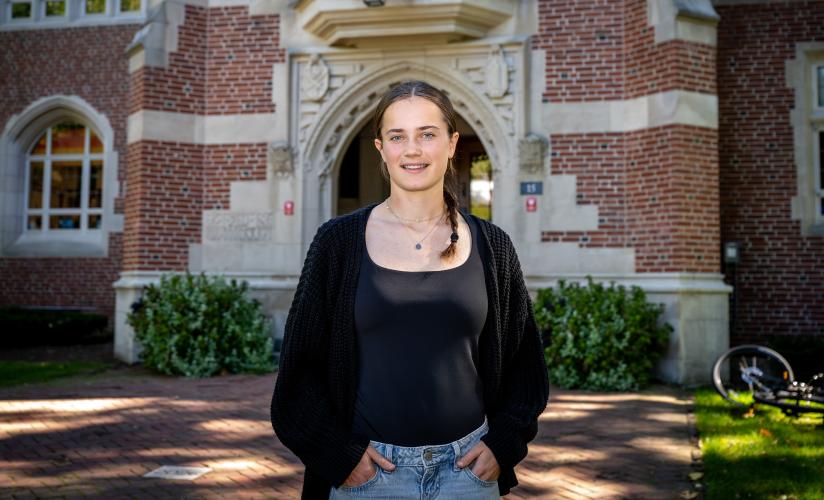
Science Teacher Susannah Phillips represents the third generation of a deep family connection to St. Paul’s School, but she’s forging her own path with her popular new Neuroscience course.
BY IAN ALDRICH
Last November, a little more than two months after starting at St. Paul’s School, Science Teacher Susannah Phillips sat down in the archives at Ohrstrom Library and found her grandfather onstage.
Phillips may have been new to SPS, but her family wasn’t. For 40 years, her grandfather, George Tracy, taught Latin, Greek, and Shakespeare at the School. He and his wife, Mary, raised three children on campus, including Phillips’ mother, Nora ’78, who returned after college to teach a summer course at the Advanced Studies Program and was later married in the Old Chapel. Tracy Memorial Theater is named for her late uncle, Jon ’83, who is buried in the School cemetery along with her grandparents.
“It was all kind of incredible,” says Phillips of learning about the grandfather who died when she was in third grade. “I found all these articles in The Pelican about his involvement with [faculty theater group] the Masters Players. I knew he acted and loved the theater but I hadn’t understood the significance it played in his life. Then there were other photos of him coaching soccer or in the library looking like a studious guy — it was a complete picture of who he was.”
Teaching, it turns out, runs in the family, though Phillips took a somewhat indirect route to it. She grew up in Massachusetts and attended Colorado College, where she played volleyball and studied biology and biochemistry with an eye toward medicine. A year into medical school, however, unsure it was the right fit, she took a leave, moved home, and found work as a middle school substitute.
“The kids were fun and I’m very energetic and sort of silly, so it just clicked for me,” she says. “Almost from the start I felt like such a natural with the kids, teenagers specifically. I had to ask myself, Why would I go back to school as a student in the hopes of feeling this way when I already felt this way as a teacher?”
Over the next three years, Phillips taught math at a middle and high school in Weston, Massachusetts. By then, she knew what she wanted: older students with deeper intellectual curiosity, a volleyball team to coach, and the round-the-clock community of a boarding school. When she began looking at New England schools, St. Paul’s topped the list.
“My mom always talked about her formmates and teachers in such a grateful way,” says Phillips. “When I think about my own schooling, I never had that kind of relationship with any of my teachers and I wanted to be a part of that.”
In the year-plus since she arrived at SPS, Phillips, like her mother and grandparents before her, has found a home in Millville. Last year, she taught chemistry and two sections of Honors Biology. This year, she’s introduced a new year-long advanced biology elective, Neuroscience, which filled all three of its sections. Open to Fifth and Sixth Form students, the course aims to answer some of the most profound questions about our own biology. Does the brain perceive reality or construct it? How do experiences physically change the brain? Why do emotions exist? “I hope that by learning neuroscience, students are also inspired to explore and question what it means to be human,” Phillips says.


Each student also chooses a neuroscience book to read and journal about, and every two weeks they meet in small groups to talk through what they’re learning. With long-form reading among young people on the decline, Phillips sees the book club as a quiet counter to the times. “One of my aims is just to encourage my students to read full books,” she says, “and hopefully inspire them to adopt reading for pleasure as a lifelong pastime.”
Phillips also serves as an assistant coach for the girls volleyball team and advises several clubs, including the digital fashion magazine Dressing the Flock, which launched last year. In between all of that, she hosts semi-regular faculty dinners, and this summer she filled the flower beds outside Armour House, where she lives, with zinnias. For Phillips, it all feels wonderfully familiar.
“I’ll be walking down that hill by the side of the Chapel, past that graduation lawn and it hits me: that’s where my parents had their wedding reception,” says Phillips. “Or I’ll think about how my grandfather walked across this same campus when he was here. It’s amazing and I feel so lucky to call it home.”