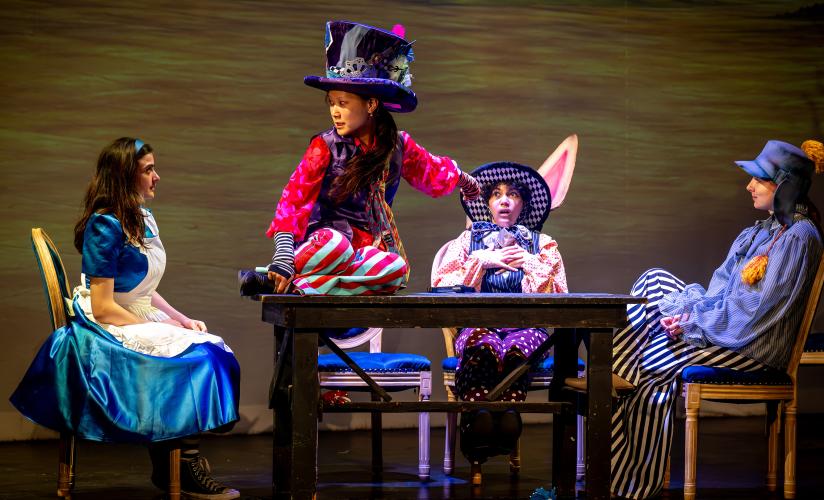
The SPS Theater Company stages an inventive Alice in Wonderland


During a day in Millville, There There author Tommy Orange takes the SPS community behind the scenes of a curriculum favorite, discusses the writing life, and sheds light on the role of art.
BY KATE DUNLOP
Best-selling author Tommy Orange, whose first novel There There was a finalist for the 2019 Pulitzer Prize for Fiction and is a staple of the Humanities IV curriculum at St. Paul’s School, spent Nov. 6 on campus. In an all-school gathering, Orange took part in an hour-long interview with Humanities teachers Beth Little and Kevin Brooks that included student questions and a wide-ranging discussion about his path to becoming a writer, his writing process and the craft; Native identity, authenticity, and performance; the power of art and storytelling; and more. Lunch with students and a visit to Little’s Creative Writing class rounded out his time in Millville.
Orange, an enrolled member of the Cheyenne and Arapaho tribes of Oklahoma who was born and raised in Oakland, California, discovered fiction in his early 20s while working at a bookstore after college, initially drawn to reading through a spiritual search for meaning. Reading turned into writing; Orange wrote There There over the course of six years, working backward from an ending at a powwow where things go “very wrong” for Native characters in Oakland and inventing voices and connections to feed that conclusion. He strategically wrote each chapter as a self-contained unit to maximize publication options and structural flexibility during revision, calling this “shuffling” approach essential to the novel’s structure.
In answering a student’s question about doubt, Orange compared a writer to a concert pianist — everyone recognizes that the pianist on stage devoted hundreds of hours to practicing a piece before performing it in front of an audience, but not everyone sees the work and discipline behind a published piece of writing.
“What you’re bringing to the page is your own consciousness as it relates to the language you build in your own mind around thinking. And so, writer’s block is doubt,” he said. “One of the things I had to figure out was how to keep working and how to make friends with doubt. And that comes with understanding that the tool that makes your writing better is the doubt. You just have to learn how to wield it and not let it take control of you.”
Brooks asked another student’s question about the key to good writing, to which Orange said, “If you know that you’re writing sentences that only you could write and you read them out loud and you feel them at that place that is sort of beyond the analyzing mind … if you feel while you’re reading them that only you could have said this and it’s meaningful to you, that only you could have said this — that, to me, is the most important part.”
Little asked him to expand on a comment that stories and art do more than comfort — they can repair. “I do believe in the power of [art],” he said. “As an artist and somebody who hopes that other people believe in art as well, I think life is made up of these tiny miracles that make us believe and make us keep going that aren’t always quantifiable when it comes to making meaning and talking about why we all are able to keep going. But I believe art is at the heart of some of these tiny miracles and it’s across fields. It’s not just in the art world. It’s everyday kindness. It’s connection. It’s vulnerability and trust and faith. All of these tiny miracles make up a single day, but we don’t often mention them. We mention the big things, the things that are most pressing or that bring us anxiety. But these tiny parts make up a vital part that we don’t always talk about. And that’s where art lives.”
Kallen Fitzpatrick ’27, who grew up 20 minutes from the Blackfeet Indian Reservation in Montana where his father was raised, enjoyed the opportunity to talk with Orange before introducing him to the School community for chapel. “There was a sense of commonality because he also is Indigenous,” Fitzpatrick said. “The fact that There There has been part of the Humanities IV curriculum for about five years shows the lasting impact Mr. Orange has had on the St. Paul’s community. His work has shaped conversations among both students and teachers, and his writing advice was very hopeful and encouraging for aspiring writers. And, despite the hardships Indigenous communities have faced, there is still so much strength, culture, and connection worth celebrating. For Mr. Orange to be a successful Indigenous author is very inspiring.”
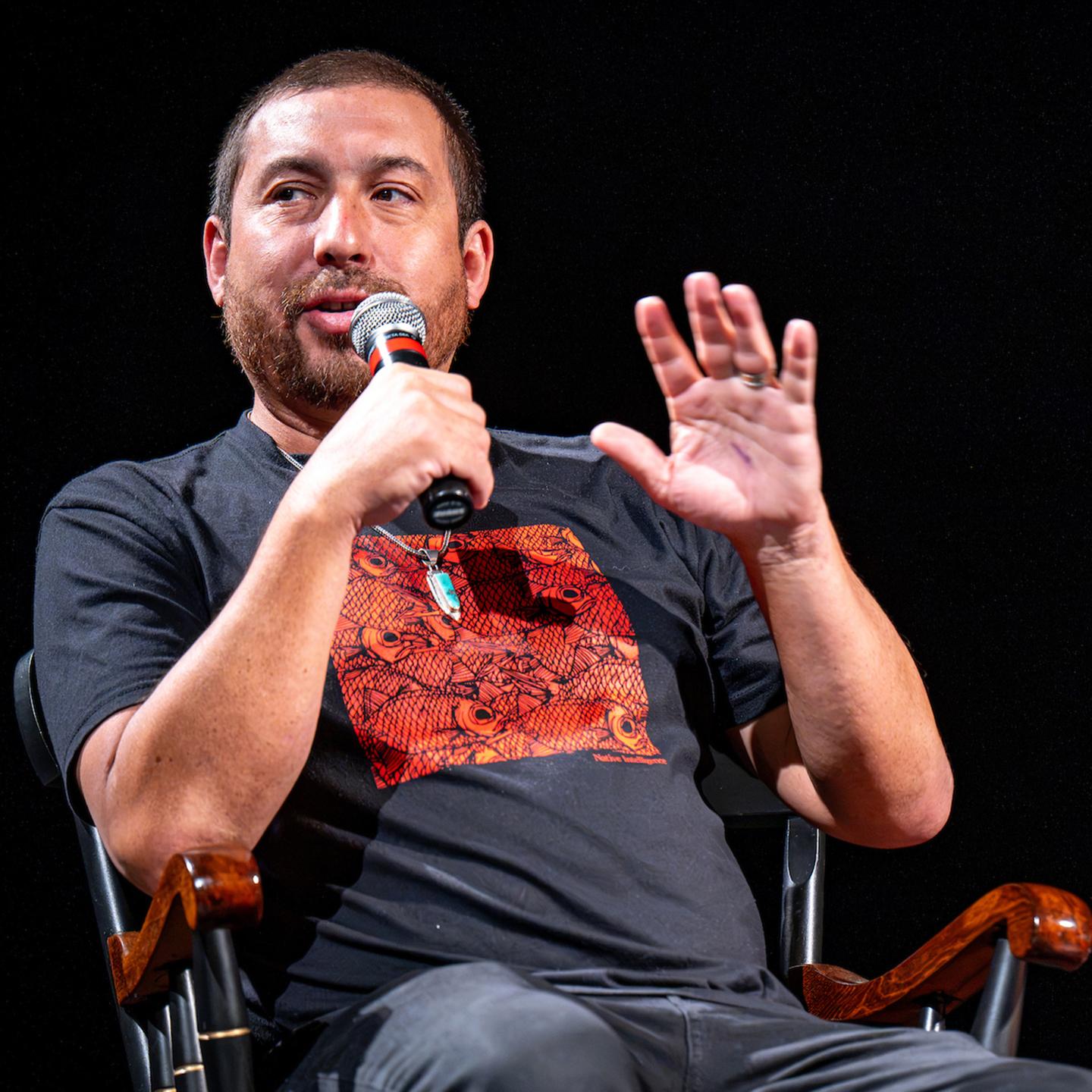
It’s everyday kindness. It’s connection. It’s vulnerability and trust and faith. All of these tiny miracles make up a single day, but we don’t often mention them.
In Little’s afternoon creative writing class, students shared their appreciation for creative expression, experimentation with perspective, and how they process emotions through writing. Jumping in, Orange added, “Something that I’ve recently liked about the writing process is sometimes the only thing that can give you perspective on your own writing is space away from it. And sometimes that could mean a year, or it could mean 10 days.”
After a few minutes of free writing, the 10 students made the most of their time with Orange, sharing their favorite lines from his story “The State” and soaking up his wisdom about the craft of writing before diving into a writing prompt he devised for them. With a few minutes left, Fin Kilbourne ’27 asked Orange about his thoughts on AI.
“I was pretty curious about it when it first came out, initially testing it to see how long I had before I would become irrelevant,” Orange said. “I never saw it do anything that scared me in terms of I’m not going to be able to have a job anymore. And then I started using it as a heavy research tool … but I ended up having to fact check every single thing, so I stopped. I don’t use it that much anymore. And I’m also not that scared of human creativity being threatened by it.”
Veering back to the writing life, Orange left the class incredulous when he pulled from his backpack the manuscript for his third novel, bristling with Post-its full of his editor’s final notes. He had six days left to consider her feedback. The students unleashed a torrent of questions: Do you read from the beginning every time? Yes. So, you have to go through each note and … Do you choose your editor? Yes, and it’s important they love your work. How long have you been working together? Since 2017. Do you get together to go over everything? No, she’s in New York, I’m in Oakland. Those are all her notes? Plus a summary letter. “Oh, my God,” a student whispered, before another series of questions dove into the nitty-gritty of final revisions and cover art creation.
“It’s a journey to get to the book cover,” Orange said. “‘There There’ has two feathers. That was a good one.”
The same could be said for the day — it was a very good one for the students of St. Paul’s.
Tommy Orange’s visit was made possible by the Dickey Visitors Fund, which enables SPS to bring significant thinkers and figures to the grounds to engage with the community. Like the student prizes of the same name, the endowment that supports Dickey Visitors is named for former trustee Charles D. Dickey, Form of 1878, and was established by his son, also Charles D. Dickey and a former trustee, of the Form of 1911.