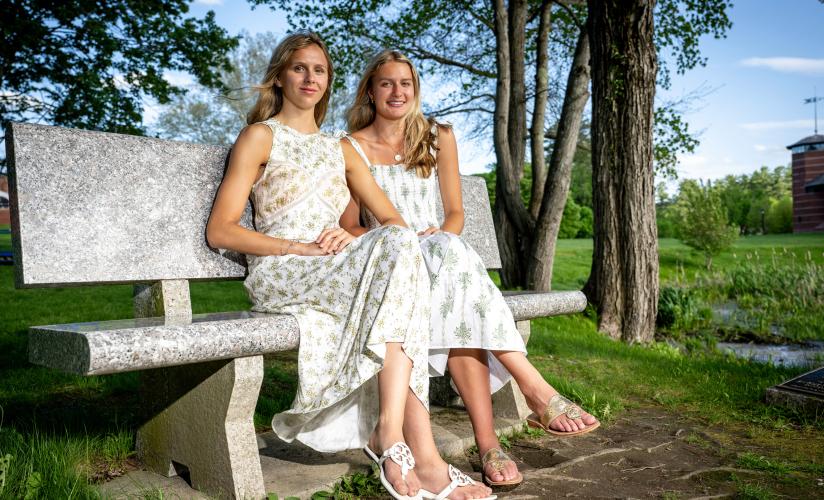
For Aedyn Kourakos ’26 and Elle Ruminski ’26, friendship is the foundation for intellectual curiosity, ambition, and growth.


Fourteenth Rector Kathy Giles opened the 171st academic year with remarks about creativity being a byproduct of preparation — that preparation “is more about process than product, and in seeking to fulfill our potential as we learn and grow throughout our lives, we will and do indeed reach the point at which we can get creative, respond to new opportunities, and ask new questions.”
Good morning, and happy new year! Special welcome to our new faculty members and new students, new to this Chapel and to chapel as we know it … who began their time in this community over the past few days and are already changing us for the good. We hope that you all feel, already, that you are among friends.
Much has happened here this summer. In addition to our summer students from New Hampshire, who for the past 70 years have been on campus for five weeks in the Advanced Studies Program, along with the teachers and interns who make up the staff for that program, the “new” here includes everything from the Kitt bathrooms to lights at the turf field to the traffic gates (which will be closed after 9 p.m. and open at 5 a.m., most days). Our campus is a beautiful place to live and work because our colleagues in Facilities work so hard to make your time here better and more comfortable. In fact, our staff members, who are not in this chapel today but whom you will see all over campus, invest hugely in the safety, well-being, organization, and great performance of the school on our behalf. We certainly could not do this without them! We pride ourselves as a community on greeting each other on the paths, and on saying thank you, so please, when you see a member of our Facilities team in the dorm or visit an office to get help with your schedule or a leave, or when you see a staff member on a path, or a FLIK colleague in the dining hall, please remember to say hello and greet and acknowledge them. You know how it feels to be acknowledged, and you have the ability to make someone’s day. Let’s be a great place not only to live and learn, but also for good people to feel great about coming to work every day to support your learning. It is a huge effort to launch a great school year. Gratitude is one of the best habits of happy people, and as we know, we have so much for which to be grateful, every day.
I know that you have had a lot of meetings going over how we hope this year will take shape. Let’s agree that on opening day, we all acknowledge that the School rules are the givens and the starting points, not our goals. The rules are the guard rails for community life here that protect the bases for expectations and trust. They also provide the guardrails for our actions and the way our actions represent our character. You know about guardrails on a highway; those steel bars are in place to prevent disaster by providing the visual and physical boundary marking the safe edge of the road. Usually — but not always — there is a rumble strip to warn you, as you drive, that you are getting too close to the edge. If that warning fails and you hit the guardrail, there will be substantial damage to you, your car and, unfortunately, to the people driving around you — but even then, hopefully, the guardrail prevents catastrophe. That’s what our School rules should do: serve as guides and warnings and catastrophe-preventers. The highways in this community are busy, and we do drive fast — there is a lot to do, and sometimes we wish there was a shortcut or a way to get something done faster or more easily — but those guardrails are critical to getting it done safely with everyone else who is on the road trying to get to their own destination. Just like driving, you need to know the rules here and use them to make sure that you align your choices and actions with the letter and the spirit of what our community expects and what everyone else depends on.
I know that an opening chapel sentence from The New York Times Athletic is somewhat rare. But like many of you, I spent some happy hours watching the World Cup this summer, and I came across this sentence, “Creativity is a byproduct of preparation,” in an article about what makes the great England striker Harry Kane the extraordinary player that he is, the truly excellent player that he is (not the most physically gifted; not the biggest, fastest, or strongest … ). Creativity is a byproduct of preparation. The article talked about the years and years of daily practice that goes into being able to rely on your knowledge, skills, and training — to be able to trust your work when it’s time to perform or produce, or when the unexpected arises. Think about that idea for a moment — creativity is a byproduct of preparation — from whatever your passion or interest is. As a student, dancer, a musician, an athlete, a writer, an artist, everything we do here is in large part about laying in the preparation our students need to be able to become truly excellent in the things that interest you and in the person you want to be. That excellence, or at least being on the path toward it, is actually the important part of “prep school” — developing the knowledge and skills, general and special, necessary not just to prepare for college but to prepare for life — the life you want to be able to choose. Dedication to the pursuit of excellence in character and scholarship is a critical element of our mission at St. Paul’s School, and over your time here, we will work on the dedication, the pursuit, and the actual excellence of mind, body, and spirit that we hope will become yours not just here but throughout your life. In the long run, being good at life turns out to be much more important than being good at school.
When you are prepared — when you have done the work to be prepared — so much more is possible than what you thought you could do.
Creativity is a byproduct of preparation. It’s totally fair to sit here today as a student looking at the year ahead and maybe be a little weary of preparation. After all, it’s been at least 10 years of school for everyone, and looking ahead, there’s at least four to eight or 10 more. You’re in the prep years — years that are all about learning and training and discipline and habits, the preparation that sets you up to recognize and then chase your interests into becoming the life you choose. Preparation isn’t necessarily fun; it is, in fact, usually a lot of work. But it’s like being in the weight room or the practice studio. You can’t just go there, show up, and expect to get stronger or to play better without actually lifting the weights or practicing your instrument; nor can you go, watch someone else put in the work, and expect to benefit yourself from just having showed up to watch. No, to get stronger, to play better, to grow, you must do the actual prep work yourself. And when you build and develop your skills, knowledge, habits, and discipline successfully — and it usually takes some time and never happens as quickly as one hopes — when you’ve done the preparation, then your ability to be creative when a challenge presents itself becomes your natural response. You get an idea that you know how to execute; there’s a change you can figure out how respond to. I’ve seen you do it — when one of our dancers choreographs a piece for members of the company around a specific idea, then has to adapt the piece because of an injury; when a basketball player responds to a broken play with a brilliant pass; when one of our ASEP student’s experiment fails, but something else important gets discovered or done nonetheless. When you are prepared — when you have done the work to be prepared — so much more is possible than what you thought you could do. When you are prepared, you are ready to get creative — and there is a lot of joy in creativity, however we get to experience it, as we all know.
So, I invite you to think about your work this year — your preparation this year — as the foundation you are building for the life you want to choose, even if you don’t know yet what that is going to be. Nobody can really know that, yet, which is again a vote for broad and deep preparation. And I hope we can agree that your capacity as an ethical thinker and a moral human being are the most fundamental foundations and skills on which you are building your life. As we begin the year, I want to take a moment to address specifically the role that artificial intelligence might play in developing your capacity to become creative, to be able to apply strong thinking, imagining, reasoning skills to the ideas you have and the challenges you might face. Because in the weight room or practice studio of training your brain, you need to do the work to build the foundation that makes you prepared for the creativity you want.
The writer Brett Stephens framed this issue well when he wrote in The New York Times in early August:
This column isn’t so much an argument as it is a plea: Don’t use artificial intelligence to help you write. Never let AI do your writing for you. Don’t use it for school papers, work briefs, letters to your in-laws, speeches at your company gathering or emails (however perfunctory) to your colleagues or friends. Don’t let it organize your notes. Don’t let it suggest an opening sentence, a segue, or a closing paragraph. Don’t ask it to write a first draft and pretend that editing that draft somehow makes it your own. It doesn’t.
Do none of these things not because they are unethical. Writing with AI is unethical when it’s a deception: when you pass off words, ideas, and information as your own when they aren’t. An acknowledgment can largely address the problem. Do none of these things, either, not because you might be able to learn to write better than an AI can. Pretty soon, if not already, you won’t, just as you can’t outrun a car or outplay a chess app.
The problem with writing with A is that it’s mentally enfeebling — an escalator toward a result when you really need to make a daily habit of taking the stairs. As it becomes ubiquitous, it undermines not only our individual ability to write but also a society’s collective ability to reason, a culture’s inner capacity to create and everyone’s reason to care.
There will be occasions on which AI is a great tool, and your teachers will help you navigate the ways you can use it as a tool while you develop your strengths and skills as the tool-user, as the craftsman of your work — writing, sure, but across the academic disciplines, as you get stronger and stronger as a thinker. Our dedication to the pursuit of excellence in character and scholarship is all about preparation, and it is totally connected to your lives as citizens of this world. Protect your agency, your independence, and your integrity; as last year’s Student Council President Henry Wilson ’26 said, don’t let anyone or anything do your thinking and preparation for you, no matter how easy or inviting it might seem at the time. Every homework assignment, every practice, every rehearsal, is a brick on the path — a brick that we lay with our own hands and our own mental, physical, and spiritual muscle. It has never been easier to cheat or to fake it. But when you don’t know what you need to know, when you are not strong because you haven’t put in the prep, you limit your choices because you don’t have the knowledge, skills, and strengths you need to perform the way you hope. Preparation is more about process than product, and in seeking to fulfill our potential as we learn and grow throughout our lives, as we do all this work, we will and do indeed reach the point at which we can get creative, respond to new opportunities, and ask new questions.
I’ll close this morning with an excerpt from a letter I received last week from Dr. Fred Lovejoy, a beloved and highly respected professor of pediatrics at the Harvard Medical School. Fred graduated from St. Paul’s in 1955, and he is known to many of us here as a regular visitor and supporter, often joining us when one of the Lovejoy Science lecturers is here to present. Fred glows with optimism, energy, curiosity, and warmth; he joined the staff at Children’s Hospital more than 60 years ago and has been accorded an extraordinary set of honors commemorating his research, leadership, mentorship, and commitment to the enterprise and to its mission. Harvard honored him in early August with a celebration of his service to the medical school, to pediatrics, and to the medical profession. By any definition of success in the pursuit of excellence in character and scholarship, Fred is a star in the constellation of our graduates.
Fred sent me his remarks from that celebratory evening, and I think it is fitting to share them with as we recommit ourselves to our students, our community, and our work together. In describing the four most important sources of inspiration, Fred wrote:
One other powerful mentor from a prior time and era was an institution, not a person, that deserves mentioning. I attended a boys’ boarding school, St. Paul’s School in Concord, New Hampshire, an Episcopal church school. We attended the Chapel of St. Peter and St. Paul every morning and twice on Sunday. It was a school that was deeply formative in shaping my character, with its guiding principle for students being “in the service of others.” And the School Prayer, which was said often and learned by every First through Sixth Form student was, “Grant, O Lord, that in all the joys of life, we may never forget to be kind. Help us to be unselfish in friendship, thoughtful of those less happy than ourselves, and eager to bear the burdens of others.” This principle, these words, and my time at school, I believe, were highly influential in my becoming a physician.
This principle, our prayer, as we know it, is a hundred years old, timelessly wise in advising us to acknowledge the joys in our lives, but never to become so fixated or self-centered that we forget to acknowledge and respect the needs of others with kindness, inclusivity and connection, empathy and compassion — and yes, eagerness to support others’ needs. I agree with Fred that this principle, this prayer, establishing the ethical creed of our community for the past century, represents the best part of us. Our alumni cherish this prayer, no matter what their religious beliefs might be. If you haven’t yet committed it to memory, you might think about doing so. There are some important grounding principles in it that remind us that life is not just about dedication to the pursuit of excellence, but also about kindness, friendship, community, and love.
I hope that this school year, with our Sixth Form leading the building of camaraderie in our Beloved Community, we will indeed continue our steady climb toward excellence in character and scholarship together.
May it be so, and amen.