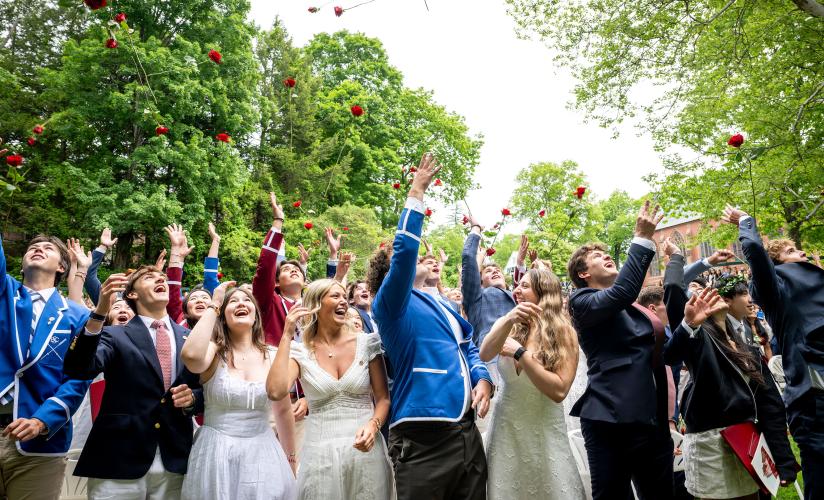
Graduates mark the culmination of their St. Paul’s experience with reflections on adaptability, purpose, and the enduring power of human connection.


Meet SPS Applied Science and Engineering Program Director Sarah Boylan
BY KRISTIN DUISBERG
Sarah Boylan joined the faculty of the St. Paul’s School Science Department in 2015, drawn by the opportunity to teach college-level molecular biology courses to high school students —and to coach softball, the sport she had played as a four-year starter at Middlebury College. At the time, the School offered a summer science program called Engineering Honors, run by then- faculty members Terry Wardrop ‘73 and Will Renauld, which offered a structure for students completing computer science or engineering internships between their Fifth and Sixth Form years. Equipped with her undergraduate degree in molecular biology and biochemistry and a master’s in biology from Harvard, Boylan was a natural fit when students interested in pursuing biology-based internships began to express a desire to participate in the program. She became the director of ASEP in 2019.
Did you see this as your path?
In college, I thought I’d go to medical school — my brother’s a doctor — but as I was getting to the end of my senior year, I became less sure it was the path for me. I’d gone to boarding school for high school at Phillips Andover, and I had a chemistry teaching fellow there my sophomore year I loved. I ended up going back to Andover and taught chemistry as a teaching fellow myself and knew at that point I wanted to teach. When St. Paul’s advertised an opening to teach molecular biology I jumped at the chance. There’s a lot of great parts about my job, but the ability to teach at such a high level to such amazing kids is definitely at the top of the list.
It sounds like being in charge of ASEP wasn’t necessarily part of that plan, however.
It was not. When students interested in Engineering Honors started to ask about biology-based internships, I volunteered to help, because Terry and Will weren’t biologists. It was at the point when we had the first big group of bio kids that we thought maybe it made sense to change the name of the program to reflect the range of disciplines they were working in. It’s not just biology and engineering. There are astronomy internships, internships for applied physics, applied chemistry, computer science. It really is the full range of applied science.
How does ASEP work? Can anyone who gets a summer internship be part of the program?
The ultimate goal of ASEP is for as many students as possible to get hands-on science experience over the summer, but we can only accommodate 12 students per year in the program. Students start out by writing a resume and a cover letter and figuring out some places they’d like to apply, and then over the fall and winter of their Fifth Form year they work on securing an internship. They do that internship in the summer, and then in the fall they bring some aspect of their work back to campus as a capstone project, which they present to the School in November. It’s very competitive and time intensive, and there are always more qualified students than we can take. Those who aren’t part of ASEP still can have amazing summer internship experiences outside of the structure of the formal program that they bring back to their SPS science classes for their Sixth Form year.
What makes for a good ASEP student?
We look at transcripts, including grades and rigor, and also at evaluations from current science teachers and advisers. Beyond that, we’re also looking for a demonstration of independence: kids who know when they can figure something out and work independently, who can troubleshoot and problem-solve. At the same time, they have to be able to take feedback and constructive criticism, and they have to buy into the cohort: this tight-knit group of 12 peers who are going to be critiquing and evaluating and supporting one another’s work. That’s really important. These are kids who are going to be working in a professional lab with professors and post-doctoral students, and that requires a real maturity. It’s a remarkable skill to have and to develop at this age.
One that sets them apart in and beyond college, I would guess.
It definitely does. I can’t tell you how many kids we’ve had who have been able to go directly into university research labs from high school because of their ASEP experience. We have a girl who did an internship in cancer biology who’s already in a cancer bio lab in her first year at Georgetown. We have another girl who finished her B.S. and her M.S. in molecular biology at Penn in four years, and now she’s getting her PhD there. At the same time, there are students who go through the program and realize that while they’re great science students and they have a great experience, they want to follow a different path.
Do you have a favorite aspect of the program?
I have lots of favorite moments, but I think it has to be when everyone comes back for the first day of school in September and they talk about what they did over the summer. In the spring, after they’ve been accepted to ASEP, they’re nervous, and when they have to introduce themselves and talk about their projects they’re all, ‘I don’t really know what much yet.’ When they return from their internships, though, it’s like, ‘Let me show you a diagram! This is what I did, and it works, and I can’t believe it!’ And then they start working on their capstones and you see the real alchemy of the cohort happen as they’re making their presentations and giving each other feedback and learning to distill and articulate what they’re doing. They’ve become true scientists and it’s amazing to see.