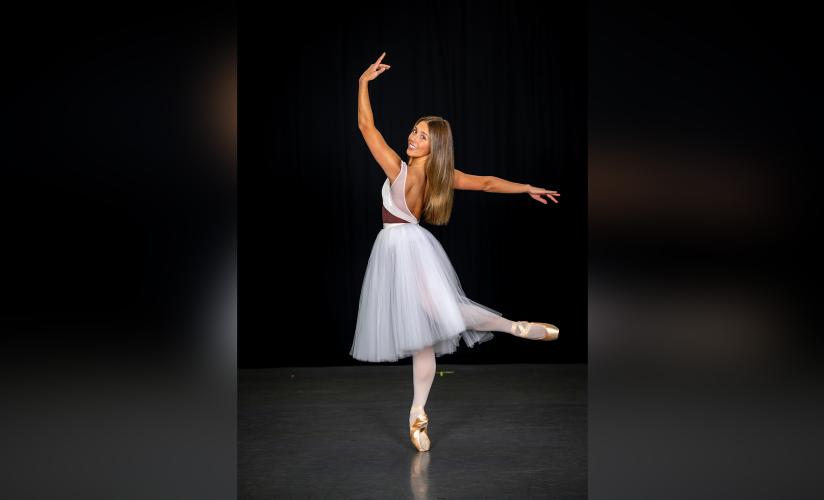
A summer at Juilliard offers St. Paul’s School Ballet Company Dancer Alexis Conway ’27 a glimpse of the future she hopes for.


Spanish Teacher Elena Bonmati and Research Librarian Sarah Yarborough present their collaboration and resulting student work at conference in Spain.
BY KATE DUNLOP
Soon after veteran educator Dr. Elena Bonmatí arrived at St. Paul’s School from her previous post as an assistant professor of Spanish at The College of Idaho, she attended Ohrstrom Library’s annual Faculty Open House. At that event promoting interdisciplinary collaboration between faculty and the library, she connected with Research and Teaching Librarian Sarah Yarborough. The conversation led to a brainstorming session for final project ideas for the eight students in Bonmati’s yearlong Spanish Seminar class. What they came up with was a bridge between the classroom and the library: a project that included research, analysis, and creative writing expanding on the legends from the Iberian Peninsula and Latin America that culminated in student-created fanzines.
While Yarborough dove into researching myths and legends from regions around Spain and Latin America about witches, vampires, wolves, a hellhound called El Dip, and more, and collected resources for a website the students could access for their own research, Bonmatí broke the project down into chunks, assigned stories, and guided her students through each step, using a flipped classroom model to make it a hands-on project: students did their research outside of class, then did their writing by hand in the classroom, where they could receive immediate feedback.
“This is cultural studies. This is pulling sources from different places [like Spanish TV and children’s literature], not only books or literature,” says Bonmatí. “They built some of the coolest projects.”
“Some of the stories are super regional; I think El Dip was the most difficult to find because the story is specific to a single town,” says Yarborough, who appreciated the chance to do interdisciplinary work and learn about new resources. “It’s why I love the creative writing part of the assignment, because the stories the students wrote become a part of this living literary tradition of these monsters.”
With support from Library Director Shawna Egan and Associate Dean of Faculty and Humanities Teacher Danny Murphy, and funds designated for faculty support, the duo presented the project at the 60th International Congress of the European Association of Teachers of Spanish (AEPE) at the University of Alicante in mid-July. Coincidentally, the university is where Bonmatí, who grew up in a Mediterranean fishing village in Spain, earned her BA and her master’s in teaching; she also holds an MA in Spanish from the University of Tennessee at Knoxville and a PhD from the University of Miami.
While Bonmatí is an experienced presenter at literature conferences, including at the XLII Congresos Internacionales de Literatura y Estudios Hispánicos in June in Mallorca, where she delivered “Echoes of Modernity: Monstrosities, Abnormalities and Fears in Early Twentieth-Century Spain and Latin America,” the Alicante conference was her first devoted to language and linguistics. For Yarborough, who has been an English teacher, school administrator, and residence staff member at private boarding schools in the United States and South Korea, there was another layer to the venture: she’s only recently started learning Spanish, but she was game to present in the language.
Their talk and PowerPoint about the process of their collaboration and guidance for recreating it was well received, and their peers were surprised to realize the student work they were viewing was created by high schoolers.
“We showed some of the student work, with their names removed, and the audience thought they were in a university level three or four Spanish course,” says Bonmatí. “They were very impressed.”
Bonmatí, too, praised her students’ ability to write and research. “They’re really creative. I was not expecting what they learned. But, I had an idea of what I wanted to do and how I wanted to do it, and it turned out well. The only thing that I needed from the students was trust and for them to be able to just follow me. They did that.”
The fanzines created from the Spanish Seminar collaboration are now housed in the School’s Archives — the first Spanish materials in the collection, according to Archivist Deanna Parsi. And, the fanzines’ positive reception inspired Yarborough to add a pre-formatted zine page to the resources that academic departments can access — now, any faculty member can find information about how to create a zine in their class.