At Home on the Camino de Santiago
David Atkinson ‘59 takes his pilgrimages one step at a time all along the way.
BY KATE DUNLOP
For more than a thousand years, since Alfonso II, King of Asturias, first traveled to see for himself if the bones in a tomb rediscovered by a hermit and identified as those of St. James the Greater were indeed the remains of Jesus’ apostle, pilgrims have made the journey to Santiago de Compostela from any number of starting points. The city, in Spain’s northwest region of Galicia, is the hub of a network of routes that all lead to its cathedral, where the saint’s remains are said to rest beneath the main altar. Santiago, along with Rome and Jerusalem, is the third major Christian pilgrimage destination; in 2025, more than half a million people will earn the Compostela, the official certificate awarded to those who complete the pilgrimage of walking the Camino de Santiago — the Way of St. James.
David Atkinson ’59 has been following the yellow arrows that point the way to Santiago since 2011, a year after “The Way,” starring Martin Sheen, touched off a resurgence of interest in the ancient tradition. For that first journey, he walked half of the 500-mile-long French route with his wife, Martha Luz. But the Camino kept calling: he did the full French Way in 2013 with the man he considers a brother, Ricardo Blanco, and repeated it in 2014. Six more pilgrimages on some of the main recognized routes of the Camino de Santiago followed, as did five books about his journeys. Now, with a sixth book in the works, Atkinson is planning his next Caminos.
THE CAMINO PROVIDES
There’s a saying among pilgrims: “The Camino provides.” Whether it’s trying to find your way, securing a bed for the night or recovering a lost hat, most find just what they need right when they need it. Atkinson shares this example:
“There are moments on the Camino de Santiago when you hurt or are lost — you’re in trouble. And every single time, I have found help.
I was on the Camino in Portugal, and it had to be 110 degrees. It was terrible. I was entirely alone on a stretch that had very few services, and I had run out of water. It was about 2 p.m., and I was scared. My mouth was so dry that my lips stuck together. I knew I still had at least two hours before I would get to my albergue.
Presently, I came into a small town but there was no café, no one around. I walked up to the first door I could find and knocked. The woman who came was so kind; she kept bringing me glass after glass of water. She even invited me into her home. I declined, but I was saved. The Camino provides. I don’t know whether I could have made it without that water.”
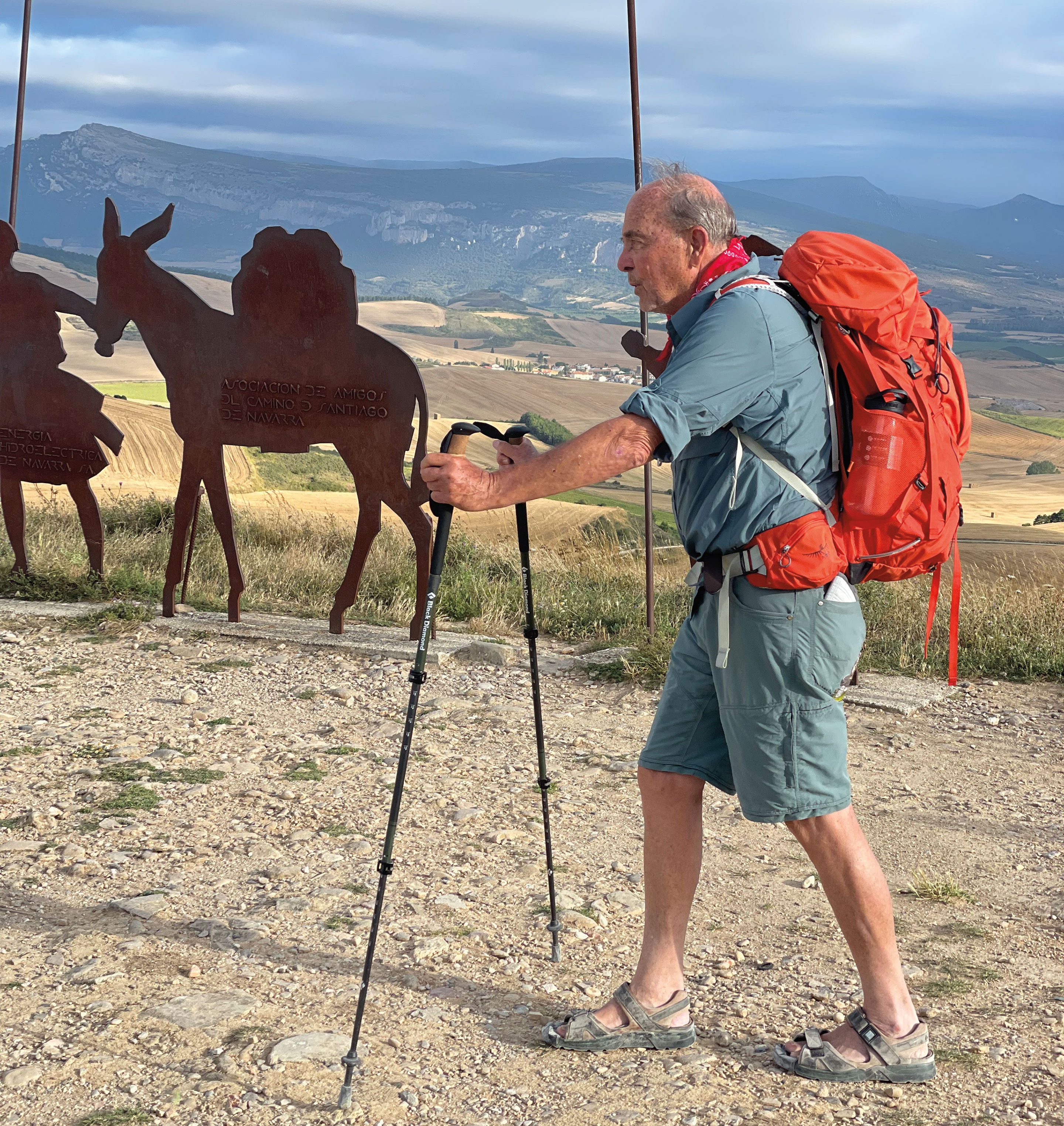
Reflecting on why people do the Camino, he says, “Some say that the French Way, the most popular route, has three stretches: the first for the body, the physical challenge of beginning a long walk over some major climbs and descents; the second for the mind, the mental test of extended expanses on the wide, open fields of the Meseta; and the final stretch for the soul, the spiritual emotion of growing closer to one’s destination in Santiago.”
The son of a diplomat, Atkinson grew up in Brazil and Burma and arrived at St. Paul’s School fluent in Portuguese. Under the formative tutelage of the late Spanish teacher Angel Rubio, he quickly became trilingual; after graduating from Princeton and Tufts’ Fletcher School of Law and Diplomacy, he built a career in development finance in Latin America. For him, the Camino is both communal and personal.
“It’s not a hike, it’s a pilgrimage. There’s a mission, which is to reach Santiago, but it’s a shared mission with your fellow pilgrims. It involves exhilaration and pain — ordeal is considered an aspect of a pilgrimage — and it involves both companionship and solitude, sometimes loneliness. It really is a time to go inside yourself,” he says. “And in my case, it brings me home. For Latin America, the mother countries are Portugal and Spain. The Camino puts me in touch with the roots of a region that I worked with and lived in. My wife is Latin. Angel Rubio gave me not only another language but a love of the culture of Spain.”
At St. Paul’s School, in addition to the beginning of a lifelong love of Spanish culture, Atkinson found support and community, and discipline with a mission — not unlike what the Camino offers and requires.
“To an extent, St. Paul’s provided a spark for my interest in long walks,” Atkinson says. “In our Fourth Form year, my roommate, Alston Boyd, convinced me to try out for crew and thus began the walks out to Turkey Pond. At the time they felt long, and I think that had something do with my love of walks in beautiful country. That and just walking around Millville; it has all stayed with me.”
Walking turned into running marathons and climbing mountains, but now, the Camino is Atkinson’s marathon and there are plenty of mountains — literal and metaphorical — along the way. No matter which route he takes, though, his arrival in Santiago is always emotional.
“The first time I arrived, I was moved to tears by the fact that I had actually done it,” he says. “And then there was 2022, when I did the English Way and formed a bond with fellow pilgrims that made the experience exceptional. In Santiago, I was greeted by a member of our group who recorded my arrival through the tunnel that takes you down to the enormous plaza in front of the cathedral. There is always someone playing the gaita, the Galician version of a bagpipe, and its sound always moves me. As I walked into the plaza and was embraced by all my friends, I couldn’t stop the tears.”
If there’s one thing Atkinson has learned on his pilgrimages, it’s patience.
“It doesn’t sound very profound, but believe me, when I realized that I could walk 25 kilometers a day — slowly, but just keep it up, one step after another — that has taught me that if there’s something I have to do in life, just take one step and then another and just do it. Don’t feel discouraged by the length or distance of whatever it is you are trying to achieve,” Atkinson says. “It’s important to just keep going. You’ve got to keep going.”