Historian and 2026 St. Paul’s School Schlesinger Writer-in-Residence Marci Shore explores archival research, Eastern European history and the moral importance of understanding another person’s experience.
BY KATE DUNLOP
History is full of questions, many with no easy answers. But the people of a time often leave clues, including in letters and diaries that find their way into archives and the hands of historians. Reading those sources, says Marci Shore, PhD, chair of European intellectual history at the University of Toronto and the 2026 St. Paul’s School Schlesinger Writer-in-Residence, is thrilling and seductive — and guilt provoking, because it’s a profound invasion of somebody’s privacy. It’s also vital for finding the details that make the past real and understandable.
Shore, a Slavicist whose research focuses on the intellectual history of 20th and 21st century Central and Eastern Europe, spent Thursday, April 30, with the School community, participating in classes and a lunchtime writing workshop and delivering an evening lecture.
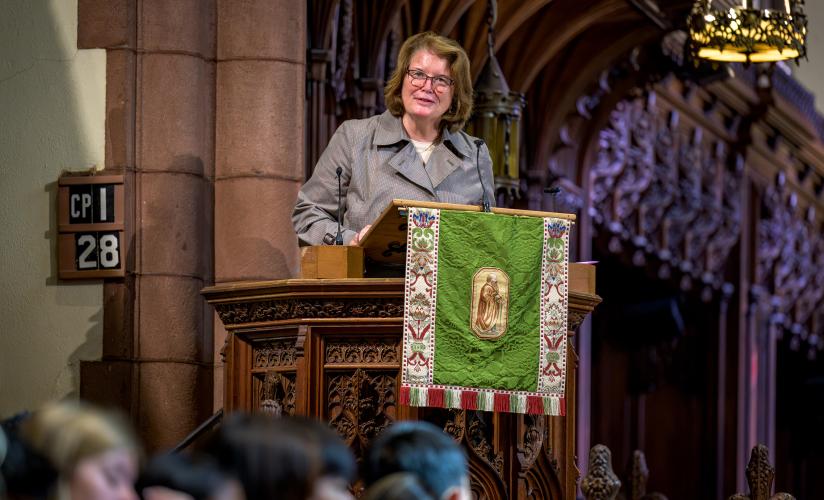
Starting the day in chapel, the historian shared how the fall of the Berlin Wall in 1989 opened Eastern European archives and helped launch her career as an academic and writer. She found those archives a bit like the Freudian unconscious, with anything too dark and disturbing for the conscious mind shut in there — often, the material is from the worst moments of someone’s life. But the exercise of being a historian, Shore says, is to project yourself into somebody else’s life, to try to understand their experience. It’s the trying that matters.
“You can never perfectly get inside somebody else’s soul. Freud would tell us we don’t even have perfect access to our own souls. He would tell us that what is most essential about ourselves is always going to be in some large part hidden from ourselves,” she said in her chapel talk. “But that doesn’t mean that we can’t understand anything, because between understanding nothing and understanding everything, there is a huge space. And there is a long way we can go to trying to understand somebody else’s experience, to making that imaginative leap, to making that empathetic leap. And that empathetic leap into somebody else’s experience, I do see as a cornerstone of morality.”
In a class on World War II taught by Humanities Teacher Maj. Kevin Brooks, the discussion turned to memory politics and how people emerge from totalitarian regimes — which is essentially the question of how to tell the story of the past. “Generally speaking, to survive, you have to have made some compromises. There are very, very few people who get out with clean hands and nobody gets out without trauma. That would not be human,” Shore said. “So, who do you blame for all the suffering? … How do you apportion blame?”
Shore, who earned her BA and PhD at Stanford and her MA from the University of Toronto, is the author of Caviar and Ashes: A Warsaw Generation’s Life and Death in Marxism, 1918–1968 (2006); The Taste of Ashes (2013) and The Ukrainian Night: An Intimate History of Revolution (2017). She translated Michał Głowiński’s Holocaust memoir The Black Seasons from the Polish as well as many articles. She is the recipient of a Guggenheim Fellowship for her forthcoming book about phenomenology in East-Central Europe In Pursuit of a Certain Truth: The Lives and Loves of a Central European Idea. Before her move to Canada, she was a professor of history at Yale University.
In the writing workshop moderated by Humanities Teacher Beth Little, Shore shared that she had always wanted to be a writer and found truth to be a better source of inspiration than fiction. Always keep a notebook handy, she advised, to brainstorm scenes and record observations; search for the granular details in sources that will make an historical person come alive, and revise, revise, revise. Young aspiring writers in particular, she suggests, should read good literature, study other languages, and know that each story demands its own structure.
The Schlesinger Writer-in-Residence Program
The Schlesinger Writer-in-Residence Program was established by Richard and Sheila Schlesinger in memory of their son, John-Christophe ’92, who died at age 23 in an August 1997 car accident soon after earning his master’s degree from Stanford. A passionate reader and writer, Schlesinger was looking forward to launching a career in journalism and was set to start work as a freelance newspaper writer.
The program invites professional writers in a variety of genres to visit the School and meet with classes, conduct writing workshops, offer public readings and lectures, and meet informally with students and faculty to generate and foster enthusiasm for creative writing.
Previous speakers include Pulitzer Prize-winning author Eliza Griswold ’91, translator and novelist Lily Meyer, historian Jonathan Brunstedt, U.S. Poet Laureate Donald Hall, screenwriter James Vanderbilt ’94, and authors Lorene Cary ’74 and Janice Lee ’90.