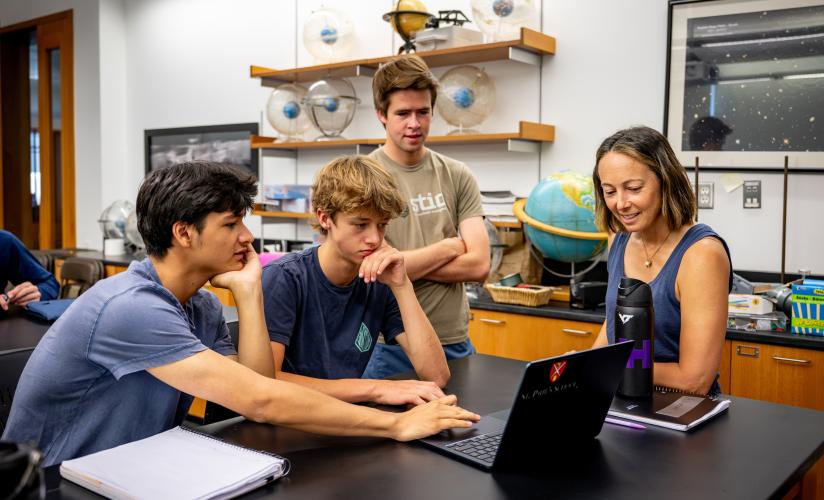
ASP Astronomy helps students develop an appreciation for the universe — and their place in it.


Students in the ASP Media and Society course gain hands-on experience in reporting, interviewing, and audio production — and an understanding of why media matters.
BY IAN ALDRICH
This summer, a new campus-only internet radio station went out across the St. Paul’s School grounds. On ASP-FM, students spearheaded programs on sports, music, culture, and nature. Behind the scenes was teacher Andy Stuhl of the Advanced Studies Program’s Media and Society course, showing students that in a media landscape this noisy, what you make is just as important as what you consume.
That hands-on experience was central to Stuhl’s five-week course, which paired the study of existing media research with the chance for students to become newsmakers themselves.
“Whether they want to be journalists or not, we’re all immersed in this media world throughout our everyday life,” says Stuhl, who was aided by two interns: Sylvia Barresi, a rising junior at the University of Connecticut, and Matthew Desrochers, a 2021 ASP alum and newly minted graduate of Bard College. “So you sort of have to be an expert in order to navigate it. You have to know, among other things, how people might try to use the media you’re consuming to manipulate you.”
Stuhl brings considerable experience in these issues and deep ties to the SPS community. For the past year, he’s worked as an assistant professor in the Department of Communication, Media, and the Arts at Seton Hall University, teaching courses in sound production, media studies, and the cultural study of sonic and computational technologies.
Prior to relocating to New Jersey, however, Stuhl lived at SPS. His wife, Leigh Kaulbach ‘08, taught fine art at the School for seven years, the last three as head of the Arts Department. The couple cherished their lives at Millville. “Leaving what we had here was certainly bittersweet,” he says.
But he didn’t have to wait long to return. Last summer, Stuhl taught a section of Writing Workshop at the ASP. This year, when the opportunity arose to return to campus and rethink the program’s media course, he jumped at the chance.
“I had always admired the ASP, and so the chance to be a part of it was really exciting,” says Stuhl.
At the center of the course was the launch of ASP-FM. With Stuhl’s guidance, the class conceived and produced a rotating lineup of programs that were as wide-ranging as the students themselves. In one ambitious example, a class member spearheaded a program that profiled each of the 16 different ASP courses, interviewing a raft of teachers and students. In another, a group of students became so enamored with a small library of natural sounds they had recorded around campus they decided to share their collection through a program called ASP Meditative Radio.
“That was an example of the students leading the way,” says Stuhl. “I hadn’t imagined that kind of programming, but the kids got excited about it and it was cool to see them follow that energy and I think it helped accelerate how they bonded.”
ASP-FM also taught students the art of the interview — a skill that, Stuhl says, translates across a host of different careers. “We did a lot of preparation,” says Stuhl. “Going over how to put together a good set of questions and looking at the degree of pre-planning and research that’s necessary to get a good interview.”
In another exercise, Stuhl had students closely analyze a favorite media outlet — picking apart what works, and examining the editorial choices producers made in putting the program together. “It’s about getting them to look at our larger media environment and think about how they might reshape it,” says Stuhl. “What kind of choices would they make?”
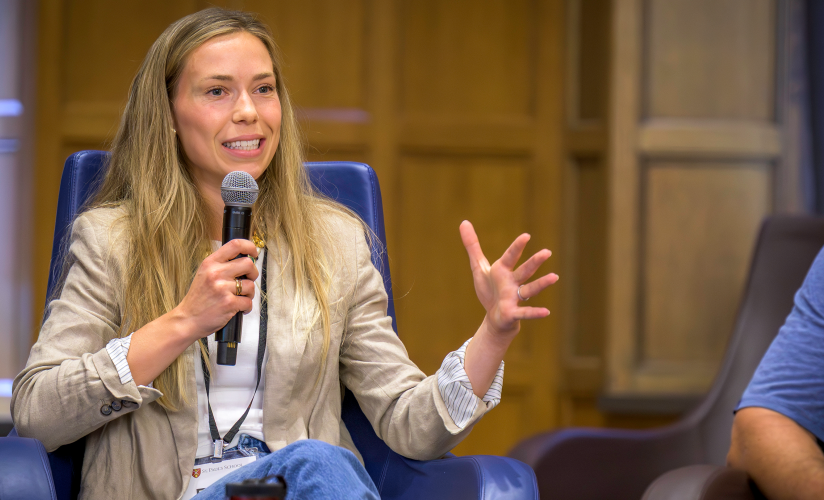
Stuhl’s class drew on outside help, too. New Hampshire Public Radio (NHPR) reporter Annmarie Timmins visited the students to talk about her own career in journalism, and there were field trips to the headquarters of both NHPR and the Concord Monitor.
“The core of the class is about developing critical thinking,” says Stuhl. “These students came here as pretty sophisticated media thinkers, so it was really a matter of helping them become even more critical, aware, and reflective of their choices as media consumers. Then it was about tying those choices directly to their actions as media producers.”
By the end of the five weeks, that distinction wasn’t just something the students understood. It was something they’d done.