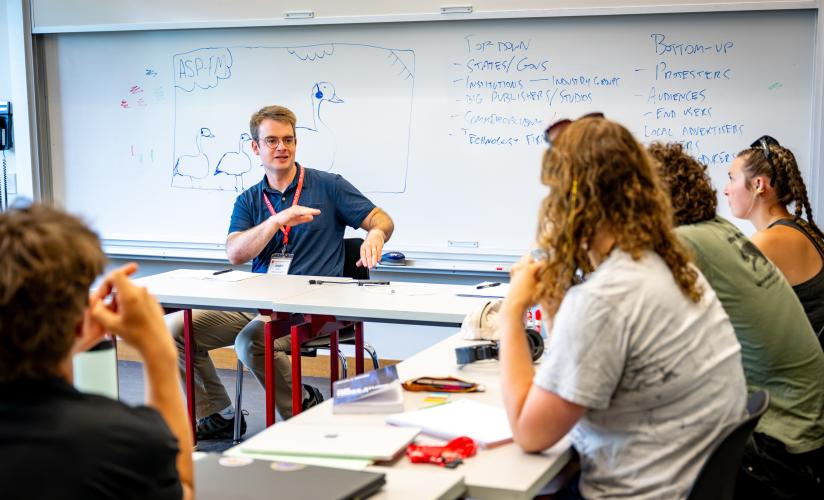
Students in the ASP Media and Society course gain hands-on experience in reporting, interviewing, and audio production — and an understanding of why media matters.


In a new ASP class, students are the subjects of their own research
BY JANA F. BROWN
“People make sense once we understand the psychology behind their behavior.” That’s the big picture overview of the Advanced Studies Program’s new Psychology course, designed and taught by longtime St. Paul’s School community member Julie Bassi, PhD, P’17,’19,’21.
Over the course of five weeks with her students, Bassi, who lived on School grounds for 18 years as a faculty spouse, has emphasized the theme of “expand the pause,” a concept that challenges the teenagers to widen the gap between what humans experience and how they react.
“The more we observe the conditions under which things happen without reacting right away,” Bassi explains, “the more we can build a pause that informs how we respond.”
Bassi introduced her students to the idea of psychologists as observers who study — not judge — those conditions. She intentionally devised the class to help students think about how they make decisions, how emotions shape reactions, and how societal factors influence behavior.
One focus of the course is the impact of cell phones and social media on youth anxiety, a phenomenon that Bassi has frequently observed during her long career as a school psychologist. Students read Jonathan Haidt’s The Anxious Generation, watched clips from The Social Dilemma, a documentary that “reveals how platforms manipulate user psychology,” and discussed how tech companies prioritize profit over wellbeing, drawing parallels to the tobacco industry. In a mock trial, students assumed various roles in a case where parents sued social media companies over teen mental health. Through direct and cross examination, students grappled with the challenge of proving the companies knowingly cause harm, while also questioning parental responsibility.
One of the most powerful activities of the summer was a voluntary weekend social media pause — a concept that initially elicited strong resistance. Bassi asked students to observe what needs social media fulfills and under what conditions it becomes compelling. They recorded reflections on what they gained, noticed, missed, and learned, reporting increased productivity, such as more time for reading, the gym, and face-to-face interactions. They also noted how habitual and addictive their phone use felt. What they missed most was contact with friends outside ASP. While most returned to social media, the experience made an impression.
“I didn’t use TikTok or Instagram at all,” says Tommy Machnik, a junior at Londonderry High School. “I did notice myself feeling a little bored at times without my algorithm. I’m not exactly sure how this will impact how I use social media in the future, but I’m definitely much more aware.”
For Bassi, who’s spent her career in New Hampshire public schools and currently works with middle schoolers in Bow, the ASP experience has been meaningful. She and husband John, the recently retired SPS medical director, moved off campus in June to a home close enough to hear the chapel bells. She describes her deep gratitude for close SPS friendships and the chance to raise their children on campus.
“By moving so close by,” she says, “it’s proving that we value our continued bonds with the community.”
In addition to Haidt’s work, Bassi’s thoughtful syllabus included Malcolm Gladwell’s Blink; Thinking, Fast and Slow by Daniel Kahneman; Michael Bungay Stanier’s The Coaching Habit; and The Anxiety Audit by local psychologist Lynn Lyons. Lyons visited class to talk about anxiety management, and students wrote and performed two-person skits in which their anxiety served as their scene partners.
“In psychology, it’s about us; we’re the subjects,” Bassi explains. “My students have had to look at themselves and learn from personal revelations so they can hopefully be more informed citizens of the world.”
Bassi also took a multidisciplinary approach to the course to highlight psychology’s expansive reach. For example, on a joint trip to Boston with the Law and Governance class, her students explored the American Revolution as a psychological case study of how the Colonists decided to rise up against the British.
“I’m trying to show them that there’s psychology behind everything,” Bassi explains, “and the more we understand psychology, the more we can apply it to just about any field.”