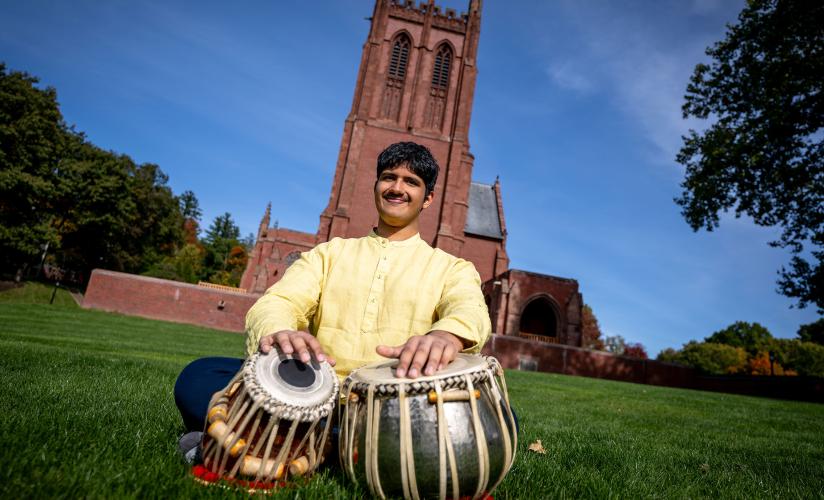
Tejas Karthik ’28 brought a lifelong love of tabla to Millville — then found a community where music, friendship, and a willingness to try something new opens unexpected doors.


A summer internship researching sudden unexpected death in epilepsy helped Motunrayo Odukoya ’27 understand her past and prepare for her future
BY KATE DUNLOP
It was a normal day when nine-year-old Motunrayo Odukoya ’27 was dropped off at a New Jersey aquatic center for another dive meet. Just as she was about to get in the pool, though, she realized she’d forgotten something — she doesn’t remember what — and started opening the pool gate so she could leave the deck and retrieve the item. That’s when the diver and gymnast who’d been training since she was little more than a toddler lost control of her body.
She remained standing and conscious but couldn’t open the gate, couldn’t move. A minute later, and Odukoya would have been immobilized in the water.
A diagnosis of benign Rolandic epilepsy derailed Odukoya’s life — no more diving, no more gymnastics, until she grew out of the childhood condition that typically resolves spontaneously during the teen years.
“I was really confused and devastated because everything I loved was being taken away,” Odukoya says. “I would ask the doctors, ‘Why do I have this?’ and they’d say they didn’t know. It’s not genetic. They didn’t know when it would end, how frequent my seizures would be, or what they’d be like. The answer to all my questions was, ‘I don’t know.’ So, I told myself that one day, I’m going to cure this whole disease. One day, I’m going to know.”
Odukoya learned the signs that preceded a seizure — the smell of burnt rubber, a sense of exhaustion, a strange-feeling tongue — and stayed silent about her diagnosis, even after hospitalizations, even when the seizures stopped after a few years. She focused on her academics, especially math and science, and she discovered that she loved volleyball even more than her pre-epilepsy sports. In her Fifth Form year, she was finally ready to open up about her experience with friends and to explore ways to make good on her vow to learn more about epilepsy. She presented on epilepsy at the Science Fair and emailed more than a hundred doctors to ask about a summer research internship. Neurologist Dr. Daniel Friedman at the NYU Comprehensive Epilepsy Center said yes. This summer, Odukoya spent six weeks working in the Grossman School of Medicine’s neurology department on a project studying sudden unexpected death in epilepsy (SUDEP), a rare seizure phenomenon that most often occurs in otherwise healthy adults, typically during sleep. Odukoya was the only high school student in the 60-person office, but she felt prepared for the work.
“NYU has this thing called NASR, the North American SUDEP Registry, which is a huge database that doctors around the world can use,” Odukoya says. “I went through patient files to make sure there was consent from the next of kin and helped get the case information uploaded to the registry so the deceased can be de-identified and their data studied to find a reason for their sudden death.”
For Odukoya, the 200 files she read of the project’s 700 were more than data points — they were glimpses into a parallel universe of worst-case scenarios for her own resolved epilepsy. “When I started working, I had no idea what I was getting into,” she says. “It’s emotional working with the records of deceased patients, reading about a girl my age or a boy my sister’s age who died. I literally cried at my desk sometimes.”
The deep dive reinforced Odukoya’s resolve to help keep epilepsy from devastating more lives and marked a change in her approach to that goal.
“When I was younger, I was selfish about why I wanted to do epilepsy research — so I could tell myself this is what happened to me and this is how I’m going to make my younger self feel more comforted,” she says. “But as I’ve learned more, it’s become about all the parents who lost a child or the people who lost their spouses; it’s about giving them an answer and spreading awareness.”
While Odukoya is cautious about the emotional toll of pursuing research or practicing medicine, she’s committed to her goal of improving the lives of those with epilepsy and is keeping her options open. Maybe, she muses, she’ll go into biotech and develop an alerting device. Or maybe medical school after all. The internship, she says, is helping her figure things out as she prepares for college.
Meanwhile, Odukoya’s Sixth Form year promises to be a busy one. She will captain the volleyball team, compete on the dive team, be a dorm prefect and editor-in-chief of the student-led fashion magazine Dressing the Flock, serve on the Chapel Council — and in the classroom, try her hand at advanced coding.
“I’m just trying to get as many experiences and take as much as I can from St. Paul’s,” Odukoya says. “The only thing I can do is live my life the way I wish I could have when I was younger — with more hope and more belief for my future.”