Tejas Karthik ’28 brought a lifelong love of tabla to Millville — then found a community where music, friendship, and a willingness to try something new opens unexpected doors.


Hugo de Saint-Aignan ’27 is one of a dozen Sixth Formers bringing research-rich Applied Science and Engineering Program externship experience back to St. Paul’s School this fall.
BY IAN ALDRICH
Two years ago, Hugo de Saint-Aignan ’27 had the opportunity to listen to Cristina Baron ’25 discuss her summer externship at the Hospital for Special Surgery’s (HSS) Laboratory for Joint Tissue Repair and Regeneration. The intensive six-week experience in New York City had come courtesy of the St. Paul’s School Applied Science and Engineering Program (ASEP), which offers 12 students each year the opportunity to design and execute a yearlong project related to a particular focus of study.
In addition to extensive wet-lab research, Baron’s work included reading papers and analyzing thousands of mouse knee x-rays for a project on anterior cruciate ligament laxity. For a future orthopedic surgeon like Baron, the work was a dream — and it was eye-opening for de Saint-Aignan.
“She was doing real research work,” he says. “I thought it was incredible that she’d been able to have that kind of experience.”
De Saint-Aignan hopes he can offer the same kind of inspiration to other students when he presents his own ASEP experience to the School later this fall.
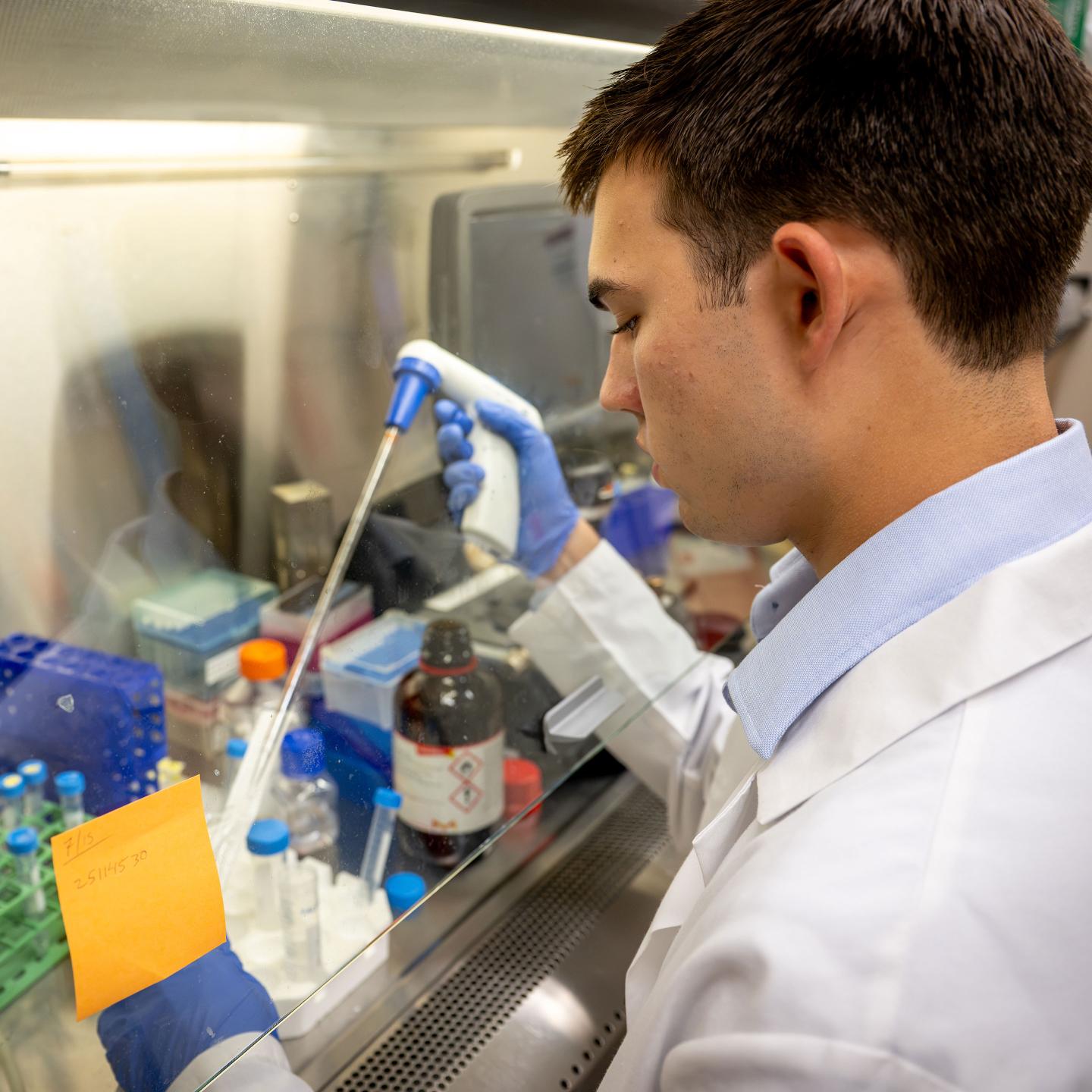
Over the summer, de Saint-Aignan completed a six-week externship at the International Center for the Study of Breast Cancer Subtypes (ICSBCS), a Manhattan-based global research organization headquartered at Weill Cornell Medicine and NewYork-Presbyterian. The work put de Saint-Aignan on the front lines of breast cancer research, analyzing patient DNA to identify genetic mutations that may one day point the way for new treatments.
“When you’re diagnosed with breast cancer, one of the things they do is they subtype it,” de Saint-Aignan explains. “And the subtypes are based on three primary things: an estrogen receptor, a progesterone receptor, and something called human epidermal growth factor receptor two. Those are the three big receptors on breast cancer cells that we want to know if you have or if you don’t have, because their presence or absence impacts treatment so vastly. If all three of those test negative, which means that a patient doesn’t express those three receptors, treatment becomes a lot more difficult.” De Saint-Aignan’s work involved extracting DNA from saliva samples taken from so-called triple negative breast cancer patients — those who test negative for all three receptors — and mapping the presence and amount of a protein called PD-L1, which plays a pivotal role in cancer’s proliferation, against each patient’s unique DNA footprint.
De Saint-Aignan relished his time in the lab. The days were long and often exhausting, but he welcomed the ownership of the work that his time at ICSBCS afforded him. “When I first started doing it I was just kind of following the steps and I understood why I was doing it, but not always,” he says. “But the work is repetitive so I really got to know every step and could begin to look at things more critically, seeing new things and building up more of a data set in my head of knowing what looks good and what looks bad.”
To have had this opportunity at my age has been pretty incredible. To design your own study, do your own research, and then be able to publish — that’s something a lot of people don’t do until they are a junior or senior in college.
The time de Saint-Aignan put in prior to arriving at ICSBCS also aided him. Early biology classes soon led him to an online summer science program with Johns Hopkins University and then a follow-up class on cancer research at Harvard the following year. Then came last year’s molecular biology class with SPS Science Teacher Sarah Boylan, who serves as director of ASEP.
“It was an amazing class because there was always something fascinating going on,” he says. “I loved it and it kind of nurtured my interest in the subject for sure.”
But it’s not just the science that undergirds de Saint-Aignan’s passion for the work. While he was too young to remember it, de Saint-Aignan’s grandmother battled breast cancer, and the impact of that time resonated with his family. Over the last several years, de Saint-Aignan has also served on the planning committee for the Boston chapter of the Susan G. Komen More Than Pink Walk, held every October to raise awareness and funds for breast cancer research.
“I have found it so much more rewarding than I could have imagined because of the people I’ve met,” he says. “So many of them have been personally affected by cancer and they have these incredible life stories that I feel so fortunate to have heard and learned from.”
It’s been the same for de Saint-Aignan at SPS. His time at the School, he says, has followed an important arc. He arrived at Millville ready to immerse himself in SPS’ academic rigor, but has also embraced aspects of its community life. He joined the football team, tried his hand at acting, and became a peer-tutor coordinator.
“What I’ve learned during my time at St. Paul’s is that versatility is such a virtue,” he says. “When I first came here I think I only prioritized my academics. To experience all the other sides of life at the School has meant a lot.”
That extends to de Saint-Aignan’s ASEP experience. If all goes according to plan, he will continue his ICSBCS research at SPS. There may be an opportunity to co-publish his findings with the lab at some point.
“To have had this opportunity at my age has been pretty incredible,” he says. “To design your own study, do your own research, and then be able to publish — that’s something a lot of people don’t do until they are a junior or senior in college.”