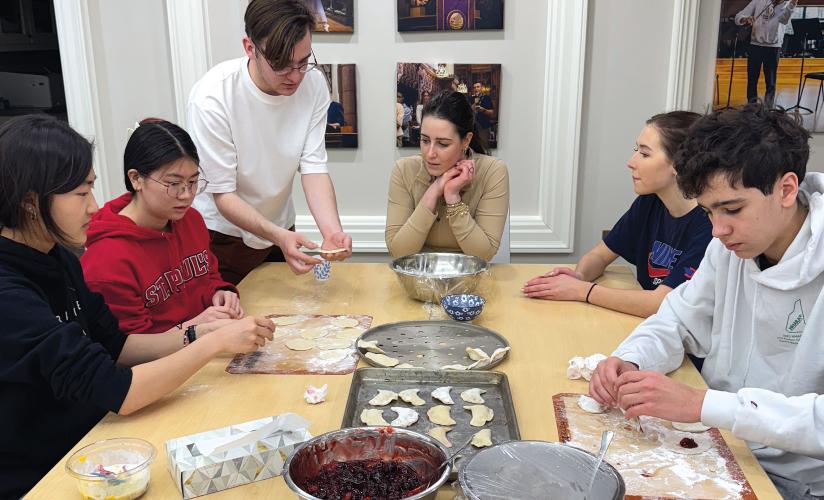
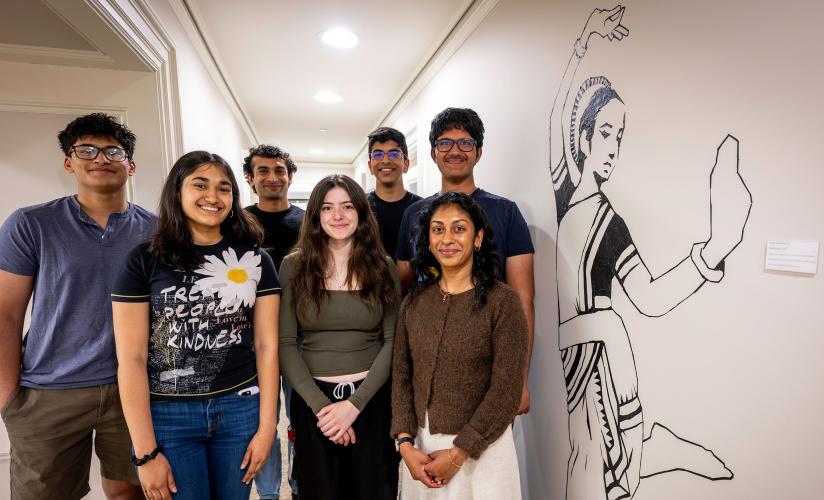
Members of the Ukraine Culture Club find camaraderie together and share a deep dive into the country with a curious School community.


NASA astronaut and 2026 Conroy Distinguished Visitor Sunita “Suni” Williams reflects on spaceflight, changed plans and the power of imagination.
BY KRISTIN DUISBERG
She commanded space stations, set a record for the most spacewalking time by a female astronaut and was the first person to complete a marathon in space. But when retired NASA astronaut and former U.S. Navy Capt. Sunita “Suni” Williams spoke to the St. Paul’s School community on Feb. 19, one of her central messages was about how to face disappointment and find new paths.
The School’s 2026 Conroy Distinguished Visitor, Williams delivered an address in Memorial Hall that provided a guided tour of her journey from her childhood as an Indian-Slovenian American in Needham, Massachusetts, to the 2024 space mission for which she is best known: a planned eight-day test flight on Boeing’s Starline that turned into a stay of more than nine months on the International Space Station. Williams’ remarks touched on the upside of that unexpectedly long mission —necessitated when technical problems with the spacecraft’s thrusters were determined to be too significant to allow for a return flight to Earth — including the achievement of scientific research and maintenance work on the space station itself, stunning views of views of Earth and space phenomena, and the camaraderie she and her fellow NASA astronaut, Butch Wilmore, experienced living and working in close quarters alongside international colleagues. At the same time, the astronaut didn’t shy away from the adversity attached not just to that mission, but also to other milestones along the course of her 27-year NASA career.
A standout swimmer and student-athlete at the U.S. Naval Academy, Williams had hoped to become a Navy diver following her graduation. “I was a swimmer, so that seemed natural … and I mention this because we gravitate toward what is familiar,” she explained. When she wasn’t assigned the diving billet, she was disappointed — but quickly reframed that disappointment as the opportunity to learn to fly and to become a helicopter pilot, which led to her flying jets and later spacecraft. “I think the lesson here is that things might not always work out the way you plan, but that’s okay because they then open other doors,” she said. “I loved flying helicopters. … Eventually I applied to NASA, and after I got my master’s degree, I got in, and that’s just part of life.”
Williams also shared a stunning space photo from a previous mission — in it, she appears to be holding the sun in her gloved hand — that she described as capturing a painful moment. Taken late into a long spacewalk during which she and her colleague were foiled in their attempts to swap out an external circuit breaker box, she explained that the image, taken when she was exhausted, is a reminder of the importance of knowing when to quit. “There’s times in life when you might just have to say, ‘You know what? Right now this is not a good idea to do this.’ … It’s hard in your life to actually have to turn around and take that understanding that so many people are watching, invested in you, counting on you on the space station to fix it and you couldn’t get it done. Luckily enough, we had another chance, and we did get it done, but there’s a couple little hard lessons in life that go on with any profession.”

Williams poses with students at the end of a robust discussion in Allyson Bryant’s Advanced Biology: Human Anatomy and Physiology class.

Williams answers questions submitted by student leaders during an afternoon session moderated by Asher Gupta ‘26 and Allyson Duardo ‘26.
In addition to delivering the Conroy Address, Williams visited three science classrooms, ate lunch in Coit with a group of students and answered questions from student leaders during a student-moderated question-and-answer session. In both Dr. Seth Cohen’s Stellar Astronomy class and Ben McBride’s Advanced Physics class, free-flowing discussion quickly shifted to questions across a wide range of subjects, including the relevance of differential equations to aerodynamics. During a session in Ally Bryant’s Human Anatomy and Physiology class, Williams shared personal anecdotes about the physiological effects of space travel and zero gravity, providing students with exceptional real-world … and out-of-this-world … applications of what they are learning in the classroom about blood pressure, bone density, muscle mass and more.
Allyson Duardo ’26 served as one of the two student moderators during the afternoon Q&A with student leaders. A member of the School’s Applied Science and Engineering Program as well as treasurer for the Student Council, Duardo says she found both the astronaut’s morning presentation and her responses to her peers’ questions inspiring. “Hearing Astronaut Sunita Williams speak left our community in what may only be described as awe,” she says. “She shared her path to becoming an astronaut, noting that she once dreamt of becoming a diver, and how, when that didn’t quite work out, she was able to pivot without losing the bigger picture. She shared how being stuck in space for longer than planned, something many considered a disaster, was not the disaster it seemed, but an extended ‘Vacation from Earth.’ Her perspective carried into her message that astronauts leave Earth not as Americans or Russians, but simply as humans.”
Toward the end of her Conroy address, Williams outlined some “audacious” next steps for space exploration, including sustainable human life on the moon and successful manned missions to Mars. As she encouraged the students gathered in Memorial Hall to see themselves as the people who will make this work a reality, she shared Albert Einstein’s famous quote about imagination: “… Imagination is everything. It is the preview of life’s coming attractions. Imagination is more important than knowledge.” On a day filled with conversations about success and failure, trust, open-mindedness and the unique challenges of running 26.2 miles from 254 miles above the Earth, it was a fitting observation by a guest whose perspective on the world is like that of few others, and an inspiring charge for an audience in whom both knowledge and imagination is abundant.

Williams pauses for a photo with SPS Board of Trustees President David Scully ‘79, P’21, Student Council President Henry Wilson ‘26 and Fourteenth Rector Kathy Giles prior to her Conroy Address in Memorial Hall.

“Imagination is everything”: Williams leaves the SPS community with her personal mantra, and an inspiring message about their own human potential.
The Conroy Distinguished Visitors Program
Established to stimulate and inspire students at St. Paul’s School, to enlarge their view of life, and to suggest directions in which they can serve their country and their communities effectively, the Conroy Distinguished Visitors Program invites outstanding leaders in various fields to the School for discussions, meetings, schoolwide performances and lectures. Conroy Visitors have included poet/author Maya Angelou, cellist Yo-Yo Ma, U.S. Poet Laureate Billy Collins, three-time Olympic gold medalist Misty May-Treanor and photojournalist and filmmaker Pete McBride ’89, among others.