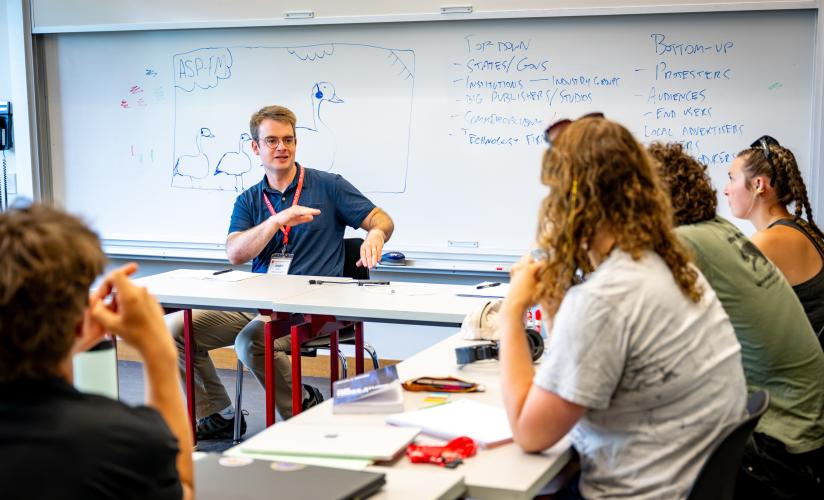
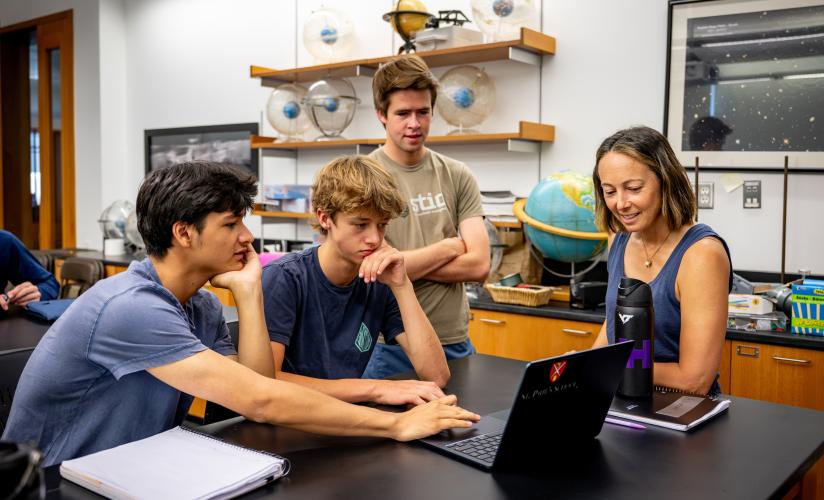
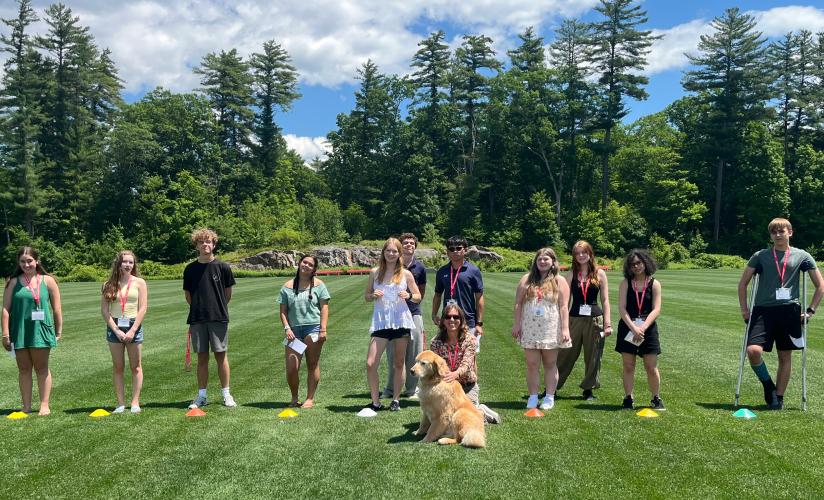
Students in the ASP Media and Society course gain hands-on experience in reporting, interviewing, and audio production — and an understanding of why media matters.


Lauri ’83, David ’85, and Josh ’87 Hornik reflect on the role the ASP played in their successful careers.
BY IAN ALDRICH
To understand what makes David Hornik ’85 tick, it helps to go back in time a bit. Before his forays into the tech world and the eventual founding of Lobby Capital, a high-profile Silicon Valley investment firm. Before Harvard Law School and the start of a distinguished legal career. Even before Stanford University, where he earned dual degrees in political science and computer music.
In some ways, Hornik’s path was defined in the summer of 1985, when he attended the Advanced Studies Program and studied Law and Government with Tom Generous, a visiting teacher from Choate Rosemary Hall, and the Rev. Ned Sherrill, then the St. Paul’s School dean of chapel and head of the Religion Department. Beyond the setting and the personal independence the ASP offered, what distinguished the experience, he says, was how dynamic the education was. There were mock policy hearings, lively debates about the U.S. Constitution, even a visit to the chambers of future U.S. Supreme Court Justice David H. Souter, who engaged Hornik and his classmates in meaty discussions about the legal process and the work of being a judge. ASP isn’t the sole reason for his success, says Hornik, but it made it a whole lot easier for him to imagine how big the world was and the kinds of opportunities that awaited him.
“It was the first time I met other students who seemed to have a big worldview, seemed to be interested in debate and conversation and exploring different kinds of ideas,” says Hornik, who grew up in Hollis and now lives in Palo Alto, California. “I was always a kid who was excited about the idea of democracy and the power it had to change lives. And now I was in this environment that reinforced the idea that the law was something that could be used for good. In many ways, it was the first time I had teachers who took what I said seriously. They weren’t just there to impart information or instruct me how to think — they really felt like young people had opinions worthy of being discussed and debated. It was amazing.”
As was the opportunity, he says, to just be himself. One of Hornik’s lasting memories is of the morning when he was invited to play his violin at Chapel. Afterward, he got to know the other musicians at ASP.
“Where I was going to [my regular] school, nobody really thought playing the violin was cool,” he says. “Or that it was all that interesting. It was just different at St. Paul’s, and being there gave me a sense of what college might be like. That there were a lot of smart people out there that I could connect with and have this amazing life. I couldn’t wait to get out there and explore that.”
Hornik wasn’t alone. His two siblings — older sister Lauri and younger brother Josh — attended the ASP in 1983 and 1987, respectively, and likewise found there an environment and a version of themselves that proved instrumental in forming their careers.
For Lauri, the founding president and publisher of Rocky Pond Books, an imprint of the Penguin Young Readers Group, her ASP experience dropped her into an environment that packed a rich appreciation for literature and theater, two things that were immensely important to her.
“I was in this class of kids who were coming to this material with a level of curiosity and insight that I hadn’t experienced before,” says Lauri, who took a major course focused exclusively on reading and performing Shakespeare’s plays. “It was a new kind of comfort for me. And then we had teachers who really loved the material, and shared that love with us and respected our intellect.”
At the center of Lauri’s ASP time was a deep dive into A Midsummer Night’s Dream, which she and her class performed from the island in Turkey Pond for faculty, fellow students, and family.
“We were close enough to shore so that the audience could hear us shouting our lines,” says Lauri. She laughs. “We had these fight scenes in the water and the girl who played Puck was hiding under a dock until she came up, so it looked like she just emerged from the water. It was all just so creative and cool. I loved it.”
“It was just different at St. Paul’s, and being there gave me a sense of what college might be like. That there were a lot of smart people out there that I could connect with and have this amazing life.”
— David Hornik ’85
So did her brother Josh, who was entering his eighth-grade year when he saw his sister perform. The performance’s out-of-the-box approach, coupled with Lauri’s stories about her time at St. Paul’s, fostered his own interest in the ASP. He would go on to study Japanese in the program, and like David, later returned as an ASP intern while in college.
“After I was accepted as a student, I was told my choice of main subject — probably some dry mathematics class — wouldn’t be taught that year and I had to choose a backup,” says Josh, who now lives in San Francisco and works in project management for a software company. “On a whim I went with Japanese, and to say that single choice had a massive impact on the course of my life is not hyperbole. I studied Japanese in college, joined an MIT program to study the culture and then moved to Japan to work as a software engineer. To this day I still study the language, watch Sumo wrestling, and am planning a trip to take my wife and 5-year-old son to Japan for the first time this year.”
The Horniks know their experience is not an isolated one. There are countless other New Hampshire families who’ve also benefited from the program, says David, and keeping that impact alive is crucial. That’s why all three Hornik siblings have made gifts to the ASP annual fund that date back as far as 1990, when Josh was still in college. It’s also why this past summer, in recognition of the appointment of new ASP Director Michelle Taffe ’85, with whom David attended the program, he made a leadership gift of $25,000 to help ensure others can enjoy what his family did.
“I wanted to make sure that no matter who you are, if you had the interest and the capacity to be a part of the program that you could afford to go,” says Hornik. “And with Michelle’s appointment, it’s a great reminder that this fantastic program doesn’t just exist, it’s in great hands.”