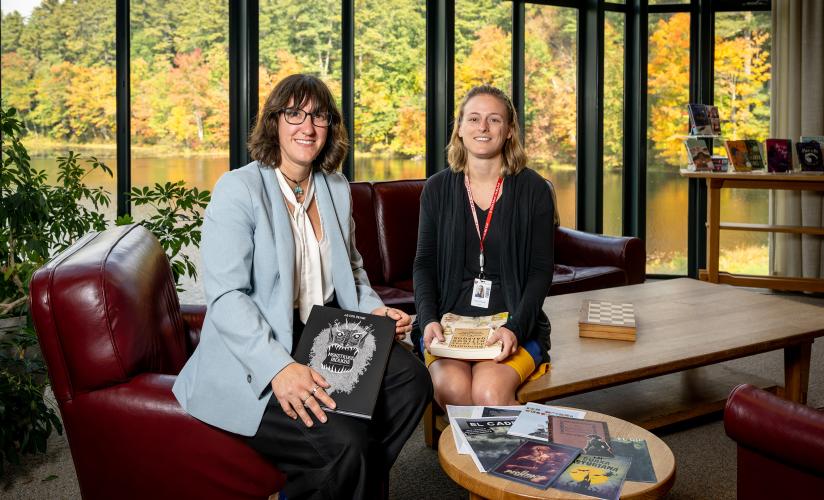
Spanish Teacher Elena Bonmati and Research Librarian Sarah Yarborough present their collaboration and resulting student work at conference in Spain.


The Hon. Bruce E. Chan ’74 reflects on being in the business of second chances
BY KATE DUNLOP
Christian Valdes was 20 years old in 1997 when he parked his car and his five friends exited for a bathroom break half a block away along a dark street in Palo Alto, California. He never left the vehicle and didn’t see them take the opportunity to rob a lone walker for money to buy alcohol and, finding none, beat him to death. Even so, Valdes was charged with murder and robbery; he was sentenced to 25 years to life in prison.
It was the era when the war on drugs’ playbook was to prosecute and imprison. At the time, Bruce Chan ’74 was a senior trial attorney with the Office of the San Francisco Public Defender representing clients facing imprisonment for possessing and selling small amounts of crack cocaine. Following nearly two decades as a public defender, Chan moved on to serve as counsel and chief counsel for the California State Assembly Committee on Public Safety for five years; he was appointed as a commissioner for the Superior Court of San Francisco County in 2004 and in 2009 was appointed to the bench by former Gov. Arnold Schwarzenegger.
Chan’s and Valdes’ paths intersected in the Young Adult Court that Chan founded in 2015. It’s a collaborative court for low-income young adults facing felony charges who seek to have their records expunged in exchange for successful completion of the program. Valdes, who spent his 22 years in prison working to change himself through education, mentoring others, restorative justice work, and participating in self‑help and youth diversion programs, is today a case manager for YAC, using his lived experience to guide youth through the program.
In a two-day visit to St. Paul’s School April 2-3, Chan and Valdes spoke in chapel, visited classes, and met with senior administrators, Clark House counselors and others.
“As public defenders, we did little to stop or slow a court system that, at least to us, seemed intent on punishing instead of treating addiction,” Chan said in chapel on Thursday, April 2. “Neuroscience tells us that our brains, especially when it comes to controlling our emotions and decision making, continue to develop until we are 25. Yet in the eyes of the legal systems in most states, you’re an adult when you turn 18. As a judge, when facing young people who have been arrested for serious crimes, I began asking myself some years ago the question of how we should respond.”
The answer was the YAC, which works with participants, many of whom have experienced poverty, abuse and neglect, community violence, homelessness, and systemic marginalization, to create a plan around their goals and holds them accountable. It considers issues of housing, food assistance, healthcare, finishing school and safe childcare and connects participants with the appropriate resources. Most important of all, Chan says, it includes honest and at times difficult conversations to understand what brought someone to the court in the first place.

The Hon. Bruce Chan ’74 and Christian Valdes engage students in discussion during Rev. Chuck Wynder’s “An Ethic of Care and Beloved Community” class.

Winant Society president Rhys Henrikson ’26 interviews Chan and Valdes during chapel in Memorial Hall.
In the Rev. Chuck Wynder’s Thursday afternoon class An Ethic of Care & Beloved Community, students asked questions that led to an exploration of justice, punishment and human dignity.
If someone dies in the course of a crime, Chan told them, there are two people who are dead: one is in the medical examiner’s office getting an autopsy, and the other is being thrown into the prison system. But he believes that young people have an incredible capacity to learn and to change — if given a chance. In his court, the message is that a person is more than the worst thing they’ve ever done, and they get that second chance.
“I have fully understood that people have done certain things in life where they need to be incarcerated. They need to be removed from public life from the safety of others,” said Chan, who was recognized earlier this year with the Aranda Access to Justice Award for his work with the YAC. “At the same time, I’m also looking at a human being there, too. And so, when I make those decisions, I am thinking about a lot of different things. I’m thinking about my duty as a judge to the public safety, but I’m also thinking about my duty as a human being and not to just reduce someone to a charge, to a stereotype, because I am affecting someone’s life and their family’s life.”
During Friday’s chapel in Memorial Hall, during which Winant Society president Rhys Henrikson ’26 interviewed Chan and Valdes on stage, Chan read from Vaclav Havel’s piece “Hope”:
Hope, in this deep and powerful sense, is not the same as joy that things are going well, or willingness to invest in enterprises that are obviously headed for early success, but, rather, an ability to work for something because it is good, not just because it stands a chance to succeed. The more unpropitious the situation in which we demonstrate hope, the deeper that hope is.
Being a judge means making educated guesses about what will happen if someone is allowed to be part of society, Chan says. But underneath it all is hope for change, that a second chance will restore a life.
“There are some people who would say Christian shouldn’t be out,” Chan said. “He shouldn’t be working … he needs to pay for what happened. And that’s kind of this bigger question that everybody here is grappling with: What is the punishment? What has to be the retribution? Is justice just revenge?”
Not in Judge Chan’s courtroom.